Table of Contents
- Why You Can Trust This Guide
- Why Most 3 Week Europe Itineraries Fail
- Who This 3 Week Europe Itinerary Is Best For
- Quick Summary of the Recommended 3 Week Europe Route
- What Actually Works in 2026 for Planning Europe Efficiently
- The Best 3 Week Europe Itinerary (Day-by-Day Breakdown)
- Alternative 3 Week Europe Itineraries Based on Travel Style
- How to Plan Transportation Across Europe
- Budget Breakdown for a 3 Weeks Europe Trip
- Packing Framework That Makes Europe Travel Easier
- Common Mistakes That Kill Europe Trips
- Beginner vs Advanced Europe Travel Planning
- Europe Trip Planning Checklist
- Frequently Asked Questions
- Final Action Plan
- More Resources From VoyagerNest
Why You Can Trust This Guide
I’ve spent several years traveling through Europe — solo trips, couples’ trips, budget backpacking, and a few splurge-worthy train journeys through Switzerland. Over those trips I made every mistake in the book: I over-packed cities, booked hotels in the wrong neighborhoods, and once tried to visit nine countries in 21 days (never again).
This europe travel itinerary 3 weeks guide is built from real experience — not copied from a generic list. I’ve tested what works, watched what ruins trips, and talked to hundreds of fellow travelers about what they wished they’d done differently. Everything here comes from firsthand knowledge.
Planning a europe travel itinerary 3 weeks long is one of the most exciting — and most overwhelming — challenges a traveler faces. You have just enough time to experience multiple countries but not nearly enough to do everything. The wrong approach turns a dream trip into an exhausting sprint.
The right approach? A focused, well-paced route that mixes iconic experiences with genuine breathing room. That’s exactly what this guide delivers.
Whether you’re a first-timer building your best 3 week European itinerary or a returning traveler trying a new route, this is the guide I wish I’d had. And if you haven’t started the planning process yet, my full guide on how to plan a trip to Europe is the ideal starting point before diving into the day-by-day specifics here.
CASE STUDY
Traveler: Sarah, 29,
first-time Europe solo traveler from Canada Original plan: 12 cities in 21 days across 8 countries After restructuring with this framework: 7 cities across 5 countries
Result: Spent 40% less on transport, felt zero burnout, called it the best trip of her life
Key insight: She had time to actually explore neighborhoods instead of rushing between train stations
Why Most 3 Week Europe Itineraries Fail
Here’s the uncomfortable truth: most europe travel itinerary 3 weeks plans fail before they even begin. Not because Europe is hard to travel — it’s one of the most beginner-friendly regions in the world. They fail because of how they’re planned.
The Biggest Planning Mistakes First-Time Travelers Make
From my experience reviewing itineraries and talking to returning travelers, the most common mistake is treating Europe like a checklist. People see photos of Paris, Rome, Prague, Barcelona, Amsterdam, and Santorini and try to cram them all into 21 days.
Transit time kills itineraries. A day that starts with a 6am checkout, a two-hour train to an airport, a two-hour flight, and a 45-minute metro ride into the city center doesn’t leave much time for actual travel. You’ve spent 8–10 hours moving. Other common mistakes: booking accommodation based on price alone (wrong neighborhoods waste hours), not factoring in jet lag for the first two days, and skipping travel insurance.
Why More Cities Does NOT Mean a Better Europe Trip
More cities means more transit days, more check-ins, more packing and unpacking. From my experience, the travelers who look back with the most joy are almost never the ones who hit 10 countries. They’re the ones who found a favorite cafe in Rome, wandered Amsterdam’s canals twice, or stumbled into a Barcelona market they hadn’t planned for.
What I’ve seen consistently: depth beats breadth. Three nights in a city lets you actually feel it. One night leaves surface-level impressions and a sore back from hauling luggage.
What Actually Makes a Europe Itinerary Work Smoothly
A successful 3 week Europe trip has three ingredients: geographic logic (cities that connect naturally), realistic pacing (minimum two nights per stop), and buffer room (at least one flexible half-day per week for delays or spontaneous discoveries).
The itinerary in this guide is built around all three. Every city connects logically to the next. No stop has fewer than two full days. And there’s built-in flexibility without wasting time.
| KEY TAKEAWAYS |
| ✔ Transit days are hidden trip-killers — minimize city-hopping |
| ✔ Depth beats breadth: 2–3 nights minimum per city |
| ✔ Buffer time is not wasted time — it saves your trip |
| ✔ Geographic logic reduces transit costs and fatigue |
Who This 3 Week Europe Itinerary Is Best For
First-Time Europe Travelers
This route is designed with first-timers in mind. It hits the cities most people dream about — Paris, Amsterdam, Rome, Barcelona — in a logical geographic sequence. If this is your first time in Europe, this itinerary gives you the iconic experiences that will make sense of everything else you’ll want to explore later.
For an expanded overview, see my complete guide on how to plan a trip to Europe.
Couples and Honeymoon Travelers
Paris and the Swiss Alps were practically designed for couples. The pacing gives you romantic dinners without rushing, scenic train rides that feel cinematic, and coastal Barcelona to end the trip on a relaxed high. Check the alternative itineraries section for a romance-first route.
Solo Travelers Wanting Easy Logistics
Every city in this route is extremely solo-traveler friendly — well-connected by train, safe, with strong hostel infrastructure. Solo travel in Europe is one of the best decisions you can make.
My guide to solo travel Europe destinations covers the safest and most social cities for independent travelers.
Travelers Balancing Budget and Comfort
This route isn’t ultra-budget (Switzerland exists), but it’s designed with smart spending in mind. I’ll show you exactly where to splurge and where to save — a 12 euro hostel in Prague doesn’t need to fund a 350 euro hotel in Paris.
Quick Summary of the Recommended 3 Week Europe Route
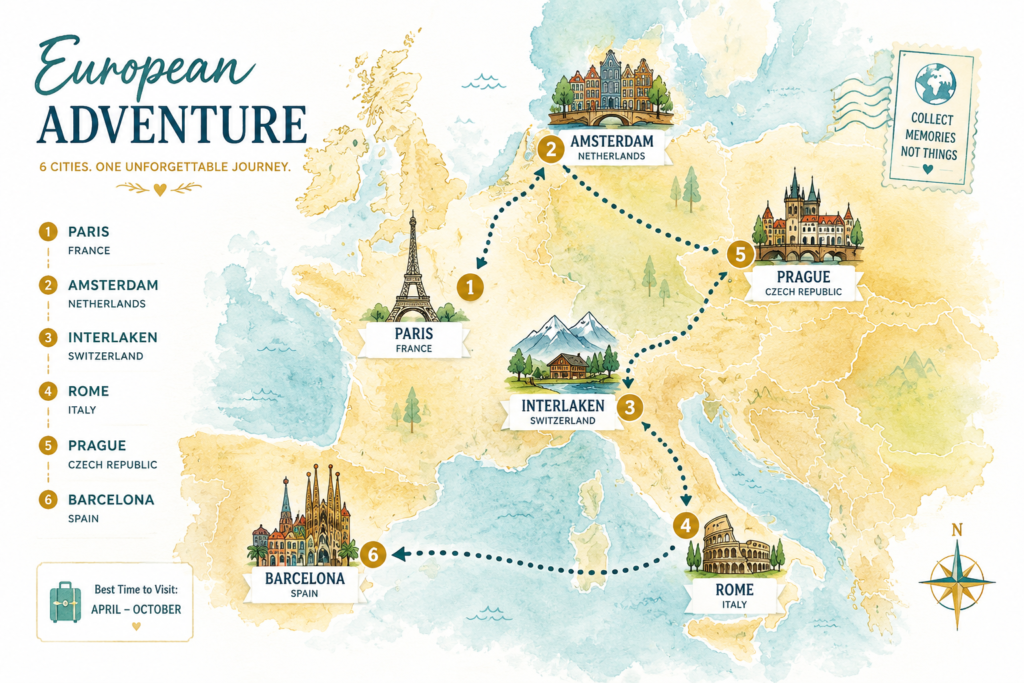
Countries Covered in This Itinerary
France → Netherlands → Switzerland → Italy → Czech Republic (or Austria) → Spain. This is a west-to-east-to-south arc that flows geographically, minimizes backtracking, and delivers remarkable variety — from French boulevards to Alpine peaks to Mediterranean beaches.
Total Budget Expectations
| Budget Level | Estimated Daily Spend | 21-Day Total (approx.) |
| Budget Traveler | 60–90 EUR/day | 1,260–1,890 EUR |
| Mid-Range | 100–160 EUR/day | 2,100–3,360 EUR |
| Comfortable/Luxury | 200+ EUR/day | 4,200+ EUR |
These figures cover accommodation, food, local transport, and activities. International flights are additional.
Best Time to Visit Europe for This Route
The sweet spot is May–June or September–October. Good weather, manageable crowds (versus July–August), and better hotel prices. July and August work but expect higher prices and queues. March–April is budget-friendly but weather in Northern Europe can be unpredictable.
Recommended Travel Pace
This itinerary is designed at a medium pace — not rushed, not glacially slow. You have 2–4 nights in each city, the sweet spot for seeing highlights without burning out. You’ll feel like a traveler, not a tourist on a schedule.
What Actually Works in 2026 for Planning Europe Efficiently
Open-Jaw Flights vs Round Trips
Here’s what actually works: book an open-jaw flight — fly into one city, fly out of another. For this itinerary, fly into Paris and home from Barcelona. This eliminates an expensive return leg and saves you from backtracking across the continent. Open-jaw tickets are usually only marginally more expensive than round trips, and the transportation savings easily offset any price difference.
Train Travel vs Budget Airlines
For most routes in this itinerary, trains win. Paris to Amsterdam: Eurostar, under 3.5 hours, city center to city center. Florence to Rome: 1.5-hour Frecciarossa. Budget airlines make sense when the train journey would exceed 5 hours. The Italy-to-Prague leg is a good example where a Ryanair or easyJet flight wins on both time and cost — if booked early.
How Many Cities You Should REALISTICALLY Visit
For a 3 week Europe trip, 6–8 cities is the realistic ceiling for a comfortable trip. I recommend 7 for this itinerary. Any more, and you spend more time in transit than actually experiencing places.
PRO TIP
Book train tickets for popular European routes (especially Paris–Amsterdam and anything in Italy) at least 6–8 weeks ahead for best prices. Italian Trenitalia and Eurostar advance tickets can cost 60–70% less than walk-up fares.
The Ideal Balance Between Big Cities and Smaller Towns
Every great europe in 3 weeks itinerary balances iconic cities with at least one slower experience. In this route, Switzerland delivers that — Interlaken, Grindelwald, or Lauterbrunnen offer a complete gear-change from urban Europe. Prague also provides a more walkable, manageable city experience after the intensity of Rome and Italy.
| KEY TAKEAWAYS |
| ✔ Open-jaw flights save money and eliminate backtracking |
| ✔ Trains beat flights for routes under 4–5 hours |
| ✔ 7 cities in 21 days is the optimal balance |
| ✔ Mix big cities with at least one smaller, slower destination |
The Best 3 Week Europe Itinerary (Day-by-Day Breakdown)
This is the core of the guide. I’ve mapped every day with purpose — not just ‘visit the Eiffel Tower’ but why, when, and what to skip to make space for things that matter more. This is the europe travel itinerary 3 weeks I’d recommend to a close friend.
Days 1–4 — Paris, France

Paris is the perfect starting point. It absorbs your jet lag because there’s enough to do at a slow pace that even a groggy first day feels magical. Give yourself 4 days — it’s one of the most complex and rewarding cities in Europe.
What to Prioritize Without Burning Out
Day 1: Arrive, check in, walk the Seine, do nothing planned.
Day 2: Louvre (2–3 hours max — it’s overwhelming if you stay longer) + Marais neighborhood for lunch.
Day 3: Eiffel Tower early morning (book online in advance), Musee d’Orsay.
Day 4: Day trip to Versailles or Montmartre, evening departure prep.
From my experience, the biggest Paris mistake is trying to tick off 15 attractions. You’ll enjoy it far more if you slow down.
Tourist Attractions Worth Your Time vs Overrated Stops
| Worth Every Minute | Skip or Limit |
| Louvre (go early, 2–3 hrs) | Moulin Rouge show (overpriced) |
| Eiffel Tower at dawn | Champs-Elysees shopping |
| Musee d’Orsay | Tourist restaurants near monuments |
| Marais neighborhood walk | Boat tours (walk the river instead) |
| Versailles day trip | Wax museums |
Smart Neighborhoods to Stay In
Le Marais (3rd/4th arrondissement): central, safe, beautiful, walkable. Saint-Germain-des-Pres: classic Paris experience, excellent restaurants. Avoid staying near the Eiffel Tower — expensive and not walkable to most attractions.
PRO TIP
Buy a Paris Museum Pass (2 or 4 days) if you plan to visit more than 3 major attractions. It skips ticket lines at most major sites and pays for itself quickly.
Days 5–7 — Amsterdam, Netherlands
The Fastest Route From Paris
The Eurostar train from Paris Gare du Nord to Amsterdam Centraal takes 3.5 hours and costs 35–90 EUR depending on advance booking. Skip the flight — by the time you factor in airport transit time, it’s not faster or cheaper.
How to Experience Amsterdam Beyond Tourist Crowds
Three days in Amsterdam is ideal. The Anne Frank House (book weeks in advance — it sells out), the Rijksmuseum, a canal bike ride, and the Jordaan neighborhood give you an authentic experience. The best Amsterdam experience: rent a bike on Day 2 and cycle to Vondelpark and beyond. It’s how locals live and it completely transforms your understanding of the city.
Amsterdam is one of the top solo travel destinations in Europe for its safety, social atmosphere, and easy navigation.
Common Amsterdam Planning Mistakes
COMMON MISTAKES
Not booking Anne Frank House in advance (sells out 2+ months ahead) Staying in the tourist center — Jordaan or De Pijp are far better Trying to see everything — Amsterdam rewards slow exploration Skipping a bike rental (the most authentic Dutch experience)
Days 8–11 — Switzerland

Why Switzerland Changes the Entire Trip Experience
Switzerland feels like a different planet after Paris and Amsterdam. The mountains, the silence, the clean air — it’s a complete sensory reset that makes everything that follows feel fresh again. I’ve always found that adding Switzerland to a europe travel itinerary 3 weeks turns a good trip into an unforgettable one. Base yourself in Interlaken — it’s the adventure and alpine hub, surrounded by Grindelwald, Lauterbrunnen, and Jungfraujoch, all accessible by train.
Best Scenic Routes That Justify the Cost
Switzerland is expensive, but some experiences are worth every franc. The Jungfraujoch train is pricey but genuinely spectacular — standing at 3,454m in the middle of summer is surreal. The Golden Pass Line from Interlaken toward Montreux is a scenic train journey that rivals anything in the world. For budget-conscious travelers: the free hike from Lauterbrunnen to Grutschalp with waterfall views is as beautiful as any paid attraction.
How to Reduce Switzerland Travel Expenses
Get a Swiss Travel Pass for your days there — it covers trains, buses, and many mountain transport links. Cook one meal per day (hostels and Airbnbs have kitchens). Use Migros or Coop supermarkets for lunch instead of restaurants. Budget accommodation in Switzerland starts around 35–55 EUR/night in dorms.
Days 12–15 — Italy
Italy is a chapter unto itself. I’d strongly recommend reading my dedicated guides on the best places to visit in Italy and how to plan a trip to Italy to go deeper on this section.
Rome vs Florence vs Venice — What Actually Fits in 3 Weeks
| City | Days Recommended | Highlights | Skip If… |
| Rome | 2 full days min | Colosseum, Vatican, Trastevere | You want a relaxed pace |
| Florence | 1.5–2 days | Uffizi, Duomo, Ponte Vecchio | On a very tight budget |
| Venice | 1–1.5 days | Canal walk, Rialto, St. Mark’s | Visiting July/August (overcrowded) |
For a 3-week itinerary, I recommend Rome (2 days) + Florence (1.5 days). Venice works as a half-day stop en route by train — it’s compact enough to experience its magic in 4–5 hours without the expense of overnight accommodation.
For the complete Italy picture, see the best place to visit in Italy for the first time.
The Smartest Italy Route for Limited Time
Fly into Rome from Switzerland (or take the overnight train). Rome: 2 nights. Train to Florence (1.5 hours): Florence 1–2 nights. Train to Venice or continue to Prague/Vienna. This north-south progression keeps you moving in one direction and avoids backtracking.
Mistakes That Waste Hours in Italy
COMMON MISTAKES
Not booking Vatican tickets in advance (queues are 2–3 hours without them) Eating at restaurants directly next to major tourist sites (double the price, half the quality) Trying to do Rome in one day — it’s impossible and leaves you frustrated Carrying a large suitcase — cobblestone streets are brutal with rolling luggage
Days 16–18 — Prague or Vienna
Which City Is Better for Your Travel Style
| Factor | Prague | Vienna |
| Budget | One of Europe’s cheapest capitals | Mid-range, similar to Western Europe |
| Architecture | Gothic, Baroque, medieval old town | Imperial, Habsburg, grand boulevards |
| Atmosphere | Young, energetic, great nightlife | Cultured, classical, cafe society |
| Best For | Budget travelers, first-timers | Culture lovers, couples, food travelers |
Budget Comparison and Atmosphere Differences
Prague wins clearly on budget — expect to pay 8–12 EUR for a full meal, 3–5 EUR for a pint, and 20–40 EUR for a solid private room. Vienna is roughly double in most categories. Both are worth it; the decision comes down to what kind of energy you want at this point in your trip.
Best Experiences Most Travelers Miss
Prague: The Vysehrad fortress overlooking the Vltava river (zero tourists, incredible views), jazz bars in the old town at night, and a day trip to Cesky Krumlov.
Vienna: The Naschmarkt food market on Saturday morning, a Viennese coffee house breakfast (Cafe Central or Cafe Hawelka), and the Belvedere Palace for Klimt’s The Kiss.
Days 19–21 — Barcelona

Ending the Trip With Relaxed Energy
Barcelona is the perfect final chapter. Mediterranean climate, incredible food, world-class architecture, and a beach — it’s built for a slow, celebratory wind-down after 18 days of active exploring. Your last three days should feel like a reward, not an obligation.
If you’re flying home from Barcelona, this is a natural departure city with excellent international connections. See also best luxury travel destinations in Europe if you want to upgrade this final portion.
Balancing Sightseeing and Recovery
Day 19: Arrive, check in, walk La Barceloneta beach, seafood dinner in El Born.
Day 20: Sagrada Familia (book online — don’t queue), Park Guell, Gothic Quarter wander.
Day 21: Morning at the Boqueria market, final lunch, airport transfer.
Final Europe Travel Tips Before Departure
Keep Day 21 light. Nothing kills the memory of an amazing trip faster than a panicked rush to the airport. Check your flight time, calculate travel time honestly, and do not schedule anything that risks your flight on the final day.
| KEY TAKEAWAYS |
| ✔ Paris (4 days): slow start, overcome jet lag, iconic highlights |
| ✔ Amsterdam (3 days): bike it, book Anne Frank House far in advance |
| ✔ Switzerland (4 days): Interlaken base, scenic train journeys |
| ✔ Italy (4 days): Rome + Florence, pre-book Vatican and Uffizi |
| ✔ Prague or Vienna (3 days): Prague for budget, Vienna for culture |
| ✔ Barcelona (3 days): relax, celebrate, fly home happy |
Alternative 3 Week Europe Itineraries Based on Travel Style
Not every traveler fits the same mold. Here are six alternative routes to customize your three week europe itinerary based on what matters most to you.
Budget-Friendly Europe Itinerary
Berlin → Prague → Budapest → Krakow → Vienna → Warsaw. Eastern and Central Europe at a fraction of Western Europe prices. Average daily spend: 40–65 EUR. This route is extraordinary value and criminally underrated.
Luxury Europe Itinerary
Paris (boutique hotel, Michelin dinner) → Cote d’Azur → Florence (5-star property) → Amalfi Coast → Rome (rooftop suite). A slow, indulgent route built for travelers who want the best version of every experience. Budget: 300–500 EUR/day.
For inspiration, see best luxury travel destinations in Europe.
Europe Itinerary for Couples
Paris → Loire Valley → Barcelona → Amalfi Coast → Rome → Swiss Alps → Zurich. Romance-first routing with scenic train journeys, candlelit dinners, and slower pacing. Fewer cities, more depth, maximum connection.
Also worth exploring: best family vacation destinations in Europe if you’re planning with children.
Europe by Train Only
Amsterdam → Brussels → Paris → Lyon → Geneva → Milan → Venice → Vienna → Prague. A fully rail-based itinerary using Eurail. The journey itself becomes the experience — scenic routes, dining cars, overnight trains, and the satisfaction of never setting foot in an airport.
My guide on slow travel pairs perfectly with this rail-only approach.
Slow Travel Europe Route
Choose 4 cities only — Paris, Florence, Barcelona, Lisbon — and spend 5 nights in each. Deep neighborhood exploration, local friendships, cooking classes, and genuine immersion. This is travel as it was meant to be experienced.
Fast-Paced Bucket List Europe Trip
For travelers who genuinely want maximum coverage in 21 days: London → Paris → Amsterdam → Brussels → Berlin → Prague → Vienna → Budapest → Venice → Rome → Barcelona. This requires 10+ cities with 2 nights each, carry-on only, and advance booking of every transport. Exhausting but achievable with the right mindset.
How to Plan Transportation Across Europe
Eurail Pass vs Point-to-Point Tickets
| Factor | Eurail Pass | Point-to-Point Tickets |
| Best For | Spontaneous travel, 5+ train journeys | Planned routes, advance booking |
| Cost | 400–700 EUR for 3 weeks | 150–350 EUR if booked early |
| Flexibility | High — hop on most trains | Fixed — tied to specific trains |
| Reservation Fees | Still required on high-speed trains | Included in ticket price |
| Verdict | Worth it for open-ended travel | Usually cheaper for fixed itineraries |
What actually works for most planned 3-week itineraries: point-to-point tickets booked 6–10 weeks in advance. The savings over Eurail are significant when you know your route.
When Flights Save Time
Use budget airlines (Ryanair, easyJet, Vueling) for: Italy to Czech Republic, any route over 5–6 hours by train, and connections requiring 2–3 train changes. Always compare door-to-door time, not just flight duration.
How to Avoid Expensive Last-Minute Travel Costs
The most expensive mistake in Europe travel: booking trains or flights within 48–72 hours. Prices can be 200–400% higher. Book accommodation and transport at least 4–6 weeks ahead for summer travel, 2–4 weeks for shoulder season.
Booking Timeline That Saves the Most Money
| Booking Window | What to Book |
| 6–8 months ahead | International flights, popular summer accommodation |
| 3–4 months ahead | High-speed trains (Eurostar, Italian Frecciarossa) |
| 6–8 weeks ahead | Major attractions (Vatican, Uffizi, Anne Frank, Jungfraujoch) |
| 4–6 weeks ahead | Remaining accommodation and regional trains |
| 2–4 weeks ahead | Budget airline flights if not yet booked |
Budget Breakdown for a 3 Weeks Europe Trip
Average Daily Budget by Country
| Country | Budget (EUR/day) | Mid-Range (EUR/day) | Notes |
| France | 60–80 | 110–160 | Paris is expensive; planning counts |
| Netherlands | 65–85 | 115–150 | Amsterdam accommodation pricey |
| Switzerland | 80–110 | 180–250 | Most expensive in this itinerary |
| Italy | 55–75 | 110–160 | Wide regional variation |
| Czech Republic | 35–55 | 75–110 | Best value in this route |
| Spain | 55–75 | 100–150 | Barcelona higher than avg Spain |
Accommodation Cost Expectations
Hostel dorms: 20–45 EUR/night depending on country. Budget private rooms: 50–90 EUR. Mid-range hotels: 90–170 EUR. Boutique/4-star: 150–300+ EUR. Airbnb in most cities falls between budget hotel and mid-range, and offers kitchen access which saves on meals.
Food and Transportation Budget
Food: Budget travelers can eat well on 25–40 EUR/day. Lunch at local markets, one sit-down dinner, breakfast at the hotel or a bakery. Transportation within cities: 5–15 EUR/day using metro, tram, or day passes. Intercity transport: factor 200–400 EUR total depending on your booking strategy.
Hidden Europe Travel Costs Most People Forget
COMMON MISTAKES
City tourist taxes (1–6 EUR per night per person — adds up over 21 days) Museum bag storage lockers (1–2 EUR each, multiple times per day) SIM card or international data plan ATM withdrawal fees abroad Luggage storage fees on transit days Travel insurance (non-optional — budget 50–100 EUR for the trip)
Packing Framework That Makes Europe Travel Easier
What Experienced Europe Travelers Never Overpack
The single biggest luggage mistake: bringing clothes for every weather scenario. In summer, you need 5 days of clothes and laundry planning, not 21 outfits. Cobblestones demand walking shoes. One smart jacket handles everything from Swiss evenings to Barcelona nights.
Rule: if your bag weighs more than 10kg carry-on, it’s too heavy. Checked luggage on budget airlines costs 20–40 EUR each way and slows you down at airports.
Essential Tech and Travel Apps
| App | What It Does | Priority |
| Google Maps (offline) | Navigation without data | Essential |
| Omio / Trainline | Train and bus booking across Europe | Essential |
| Rome2Rio | Multi-modal route planning | High |
| XE Currency | Real-time currency conversion | High |
| Booking.com / Hostelworld | Accommodation | Essential |
| International communication | Essential | |
| Google Translate | Offline language packs | High |
Carry-On vs Checked Luggage Strategy
Carry-on only is the right call for this itinerary. You’re moving cities frequently enough that checked luggage becomes a genuine burden. A 40L backpack or a 55x40x20cm roller case fits within most European budget airline carry-on limits and makes you infinitely more mobile.
PRO TIP
Pack your entire trip in one carry-on bag. This forces smart packing decisions, saves 40–80 EUR per person in checked luggage fees on budget airlines, and means you go straight from train to hotel — no baggage carousels.
Common Mistakes That Kill Europe Trips
Spending Too Much Time in Transit
Every day spent mostly in transit is a city you’re not experiencing. Build your itinerary around maximum 2–3 transit days per week, and try to arrive by early afternoon so you can explore that evening.
Booking Hotels in the Wrong Areas
A 60 EUR hotel 45 minutes from city center by metro is not a bargain when you factor in transit time and cost. In Paris, Marais or Saint-Germain. In Amsterdam, Jordaan. In Rome, Trastevere. In Barcelona, Eixample or El Born. Staying central saves time — your most limited resource.
Trying to See Too Many Countries
I’ve said this before and I’ll say it again: 5 countries in 3 weeks is plenty. 8 countries becomes a chaos spiral. The more countries you add, the more transit days you burn. Five well-chosen countries at a medium pace beats eight rushed ones every time.
Ignoring Travel Fatigue
Travel fatigue is real. By day 14 of active city-hopping, your decision-making suffers and you start resenting what should be incredible experiences. Build in one half-day per week where you have zero plans. Sit in a cafe. Read a book. Walk without a map. This is not wasted time — it’s how you sustain the trip.
| KEY TAKEAWAYS |
| ✔ Maximum 2–3 transit days per week keeps energy high |
| ✔ Central accommodation saves hours of daily transit |
| ✔ Five countries is the sweet spot for 3 weeks |
| ✔ One unplanned half-day per week is mandatory recovery |
Beginner vs Advanced Europe Travel Planning
What Beginners Should Keep Simple
Book accommodation before you arrive. Stick to the major well-worn routes. Use credit/debit cards that waive international fees. Download Google Maps offline before each city. Don’t try to improvise everything — spontaneity is great, but not when it means paying 200 EUR for a last-minute hotel room.
My article on how to make an itinerary for a trip that actually works is a great resource for structuring your planning process.
Advanced Route Optimization Tips
Experienced travelers use overnight trains to save on accommodation costs (sleeping instead of paying for a hotel room). They book train tickets the moment they go on sale (usually 90 days out in Europe). They use Google Flights and set price alerts months in advance.
How Experienced Travelers Reduce Costs Dramatically
The biggest levers: carry-on only (saves checked luggage fees), advance booking (saves 40–60% on trains), cooking one meal per day (saves 15–25 EUR), using city travel cards, and shoulder season timing (saves 20–40% on accommodation).
Europe Trip Planning Checklist
Flights
- Book open-jaw flights (fly in, fly out of different cities)
- Compare dates +/- 3 days for best prices on Google Flights
- Download airline apps for digital boarding passes
Accommodation
- Book central-location accommodation in each city
- Confirm check-in times and luggage storage options
- Read recent reviews (within 3 months) for cleanliness and safety
Transportation
- Book high-speed trains 6–8 weeks ahead
- Download Omio or Trainline app for mobile tickets
- Research city metro/tram day passes for each destination
Insurance
- Purchase comprehensive travel insurance before departure
- Ensure medical coverage includes emergency evacuation
- Keep digital and physical copies of your policy number
Documents and Visas
- Passport valid for 6 months beyond return date
- Schengen Area rules: check if your nationality requires a visa
- Carry 2 passport photos and photocopies of all documents
Budget Tracking
- Set a daily spending limit before departure
- Use Trail Wallet or TravelSpend app to track expenses daily
- Notify your bank of travel dates to prevent card blocks
Mobile Data and Connectivity
- Buy a local SIM or international eSIM (Airalo works across Europe)
- Download offline maps for every city before arrival
- Check roaming fees with your home carrier as backup
Frequently Asked Questions
Is 3 weeks enough for Europe?
Yes — three weeks is one of the best durations for a Europe trip. It’s enough time to experience 5–7 destinations meaningfully without rushing. You’ll get a genuinely satisfying trip that leaves you wanting to return, which is exactly the right outcome for a first visit.
How many countries should I visit in 3 weeks?
Four to six countries is the comfortable range for 3 weeks. Five countries — as in this itinerary — gives you meaningful time in each without the chaos of daily border crossings. Any more than six and you’ll spend more time in transit than actually experiencing places.
What is the best first-time Europe itinerary?
The route in this guide — Paris, Amsterdam, Switzerland, Italy, Prague/Vienna, Barcelona — consistently delivers the most rewarding first-time Europe experience. It covers iconic cities, has excellent transport connections, and delivers incredible variety of culture, landscape, and atmosphere.
How much money do I need for 3 weeks in Europe?
Budget travelers: 1,500–2,200 EUR excluding flights. Mid-range travelers: 2,500–4,000 EUR. These figures cover accommodation, food, transport, and activities within Europe. International flights typically add 500–1,200 EUR depending on your home country and booking timing.
Is Eurail worth it for a 3 week Europe trip?
For a fixed itinerary like this one, point-to-point tickets booked in advance usually beat Eurail on price. Eurail makes more sense for open-ended travel where flexibility is more important than cost savings.
What is the cheapest way to travel around Europe?
Night trains (save on accommodation), budget airlines booked 6+ weeks ahead, and Eastern Europe routing. Prague and Budapest are significantly cheaper than Paris and Amsterdam. Cooking one meal per day also makes a meaningful difference over 21 days.
Which countries are easiest for first-time Europe travelers?
France, Netherlands, Germany, Italy, and Spain all have excellent English-speaking infrastructure and well-developed tourist networks. The Czech Republic is also very easy to navigate despite not being a native English-speaking country.
Final Action Plan
You’ve now got everything you need to plan the best 3 week European itinerary for your style, budget, and travel goals. Here’s how to actually start — today, not someday.
The Exact Steps to Start Planning Today
- Choose your travel dates and check your passport expiry
- Search Google Flights for open-jaw options (fly into Paris, out of Barcelona)
- Book your accommodation for the first 2–3 nights in Paris
- Book Anne Frank House and Vatican tickets immediately — these sell out first
- Set up a trip budget tracker in a spreadsheet or app
- Join Reddit r/solotravel or r/travel and search your specific route for current tips
How to Customize This Itinerary to Your Budget
If you’re budget-focused: swap Switzerland for Germany (Berlin or Munich), and swap Barcelona for Lisbon. Both swaps dramatically reduce your daily costs while maintaining trip quality. If you want to splurge: add 2 nights on the Amalfi Coast between Rome and Prague, and upgrade Paris and Barcelona to boutique hotels.
What to Book First Before Prices Increase
Priority order:
(1) International flights — prices rise fast after you start researching.
(2) High-season accommodation in Paris and Barcelona.
(3) Timed-entry tickets for Vatican, Uffizi, Anne Frank House, and Jungfraujoch.
(4) High-speed train segments.
YOUR NEXT STEP
Open Google Flights right now and search for open-jaw tickets to Paris. Everything else in this guide can be refined over the coming weeks — but flight availability and pricing only get worse as your travel date approaches. Locking in your flights makes the trip real.
More Resources From VoyagerNest
Best Family Vacation Destinations in Europe | Best Places to Visit in France | Best Places to Visit in Italy for First-Timers | Solo Travel Destinations | How to Plan a Trip to Europe