Introduction
I’ve been to Italy more times than I can count on one hand — and every single time, I come back with a completely different perspective on what this country really offers. Italy is not just a destination. It’s an experience that layers history, food, landscapes, and culture in a way that genuinely no other country in Europe does quite so well.
That said, I’ve watched countless travelers make the same mistakes — cramming too many cities into one trip, skipping the south entirely, or missing the Amalfi Coast because they assumed it was too complicated to reach. In this guide, I’m going to share everything I know about the best places to visit in Italy, broken down by region, season, travel style, and experience level.
Whether you’re a first-timer planning your dream Italian vacation or a repeat visitor looking to go deeper, this is the most practical, honest, and experience-based Italy travel guide you’ll find. Let’s get into it.
Quick Answer: Top Places You Should Not Miss in Italy
The “Big 3” That Define Italy for Most Travelers
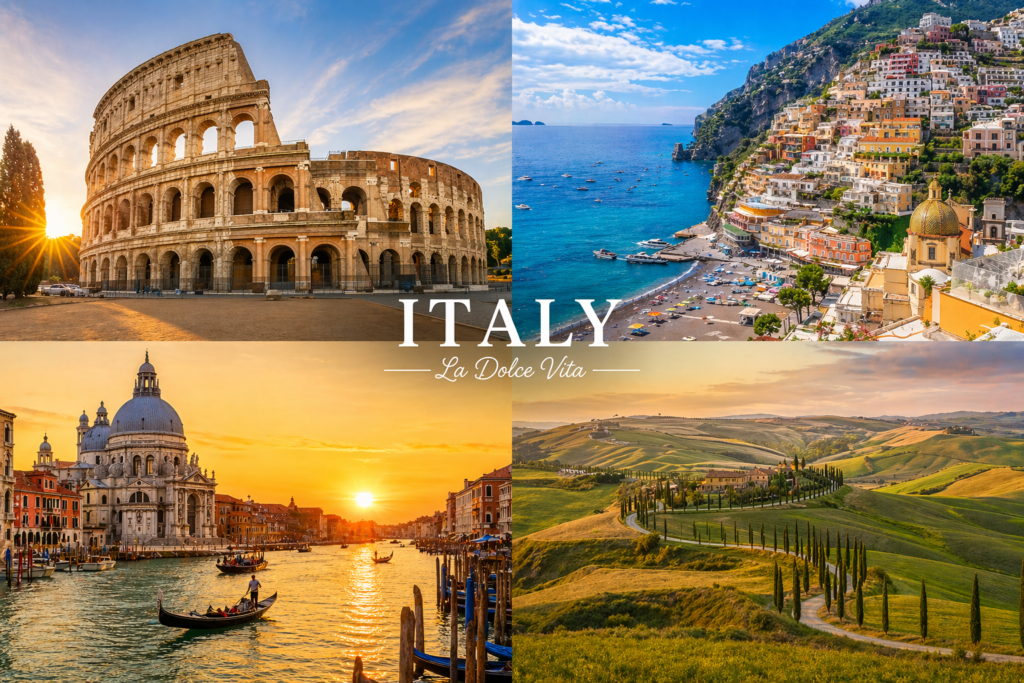
When people ask me what the Big 3 of Italy is, I always give the same answer without hesitation: Rome, Florence, and Venice. These three cities together represent the full spectrum of what makes Italy so endlessly fascinating — ancient history, Renaissance art, and romantic waterways. However, the Amalfi Coast has increasingly earned a seat at that table, especially for travelers who prioritize natural beauty and coastal experiences over pure urban culture.
Here’s how I think of each one in a single line:
- Rome — The world’s greatest open-air history museum
- Florence — The birthplace of the Renaissance, still breathing creativity
- Venice — A city that has no business existing, yet here it is, floating magnificently
For most first-time travelers, building your trip around these three places to visit in Italy gives you an immediate understanding of why Italy is consistently ranked among the world’s top travel destinations.
Top 10 Must-Visit Destinations Based on Traveler Intent
In my experience, the best place to visit in Italy depends heavily on what you’re actually after. Therefore, I’ve ranked the top 10 destinations not by popularity alone, but by the specific experience they deliver:
| Destination | Best For | Best Season |
| Rome | History, architecture, culture | April–June, Sept–Oct |
| Florence | Art, food, Tuscany gateway | April–May, September |
| Venice | Romance, architecture, uniqueness | Nov–March (off-peak) |
| Amalfi Coast | Coastal beauty, scenic drives | May–June, September |
| Sicily | Ancient ruins, beaches, food | April–June, October |
| Milan | Fashion, design, nightlife | Year-round |
| Naples | Authentic Italy, pizza, Pompeii | March–May, October |
| Tuscany | Wine, rolling hills, slower pace | April–October |
| Lake Como | Luxury, scenery, relaxation | May–September |
| Cinque Terre | Coastal villages, hiking, Instagram | May–June, September |
Which Part of Italy Is Actually the Most Beautiful? (Real Perspective)
This is one of the most searched questions I see travelers ask, and honestly, the answer is subjective — but not entirely. If you’re asking which part of Italy is most beautiful in terms of sheer natural drama, southern Italy wins every time. The Amalfi Coast of Italy alone is one of the most visually stunning stretches of coastline on the planet. The combination of sheer cliffs, colorful villages perched at impossible angles, and the deep blue Tyrrhenian Sea below creates a view that genuinely stops you mid-step.
However, for cultural and architectural beauty, central Italy — particularly Tuscany — is arguably unmatched. The rolling hills, the cypress-lined roads, the medieval hilltop towns like Siena and San Gimignano. It’s the Italy you see in movies because filmmakers can’t resist it either.
Northern Italy gives you a completely different kind of beauty — the snow-capped Alps in the background, the shimmering surface of Lake Como, the art nouveau grandeur of Milan. In other words: every region wins on its own terms.
Who This Guide Is For (And How to Use It)
First-Time Travelers vs Repeat Visitors
I’ve structured this guide to work for both camps, but let me be direct: if this is your first trip to Italy, don’t try to be clever. Stick to the iconic places to visit in Italy first — Rome, Florence, and at least one coastal destination like the Amalfi Coast. These places are iconic for a reason. The repeat visitor can — and should — go deeper into lesser-known regions like Puglia, Calabria, or the Dolomites.
First-timers need a well-designed 7–10 day itinerary with efficient routing. Repeat visitors can afford to slow down, linger in one region, and skip the tourist rush entirely.
Travelers by Goal: Food, Romance, Budget, Family
Italy is genuinely one of the most versatile destinations in the world. In my experience, here’s how different traveler types should approach it:
- Food lovers: Bologna, Naples, Sicily — skip tourist-trap restaurants near the Colosseum
- Couples: Amalfi Coast, Venice, Tuscany — romance is built into the landscape
- Families with kids: Rome (kid-friendly history), Florence, Lake Garda — structure helps
- Budget travelers: Naples, Sicily, Puglia — same authenticity at a fraction of the cost
If you’re traveling with family and looking for the broader European context, I’d also point you toward our guide on the
If you’re traveling with family and looking for the broader European context, check out our guide on best family vacation destinations in Europe — Italy features prominently there too.
How to Choose the Right Places Based on Your Travel Style
The single most useful framework I’ve developed over years of Italy travel is this: choose your anchor cities first, then build around them. Don’t book a random list of places and try to connect them — instead, pick 2–3 anchor destinations that match your travel DNA and let everything else flow from there.
Pro Tip: If you have 10 days or less, choose one region and go deep rather than trying to touch all of Italy. You’ll leave more satisfied — I promise.
Italy on the Map: How to Understand Regions Before You Plan
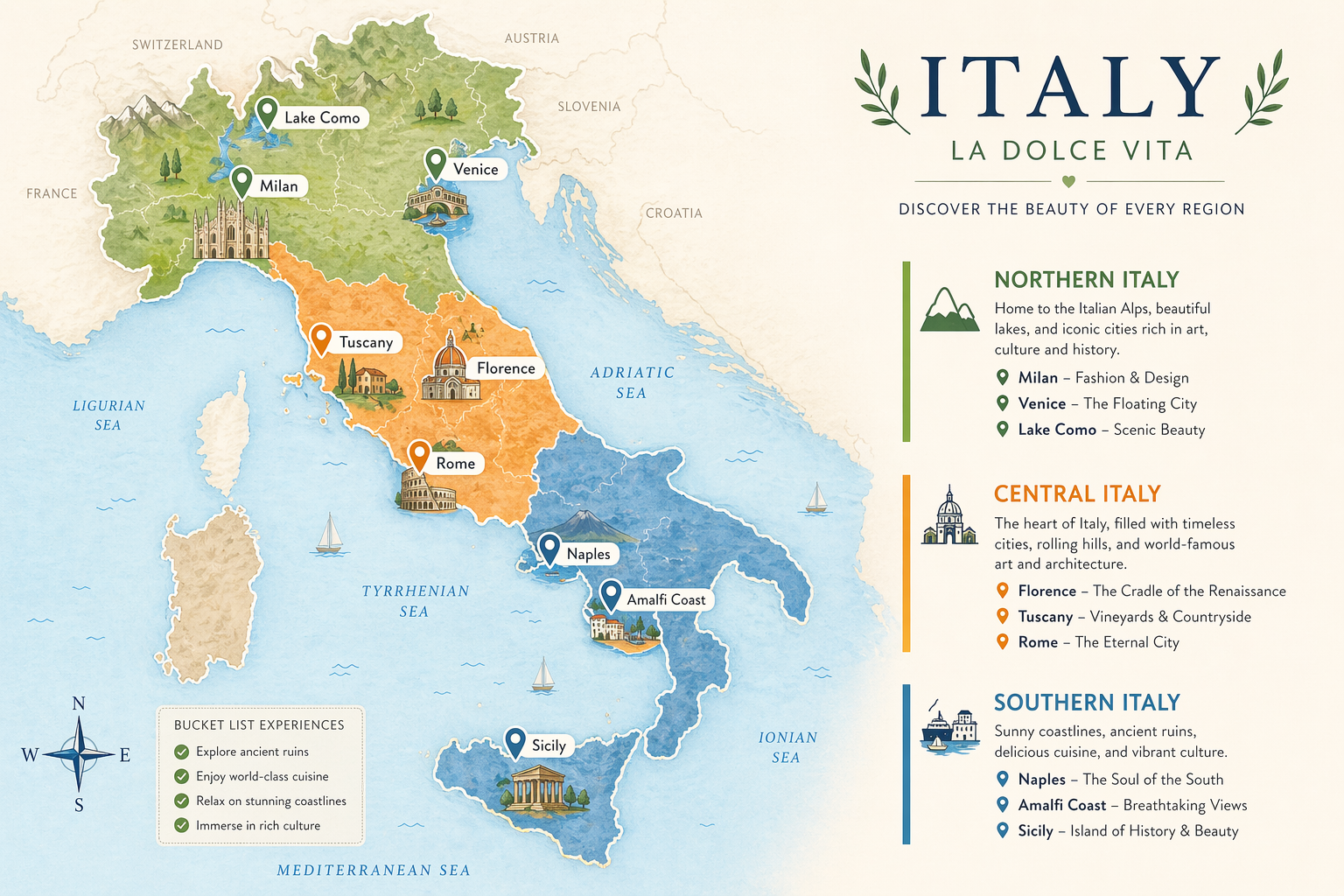
How Italy Is Structured (North, Central, South Explained)
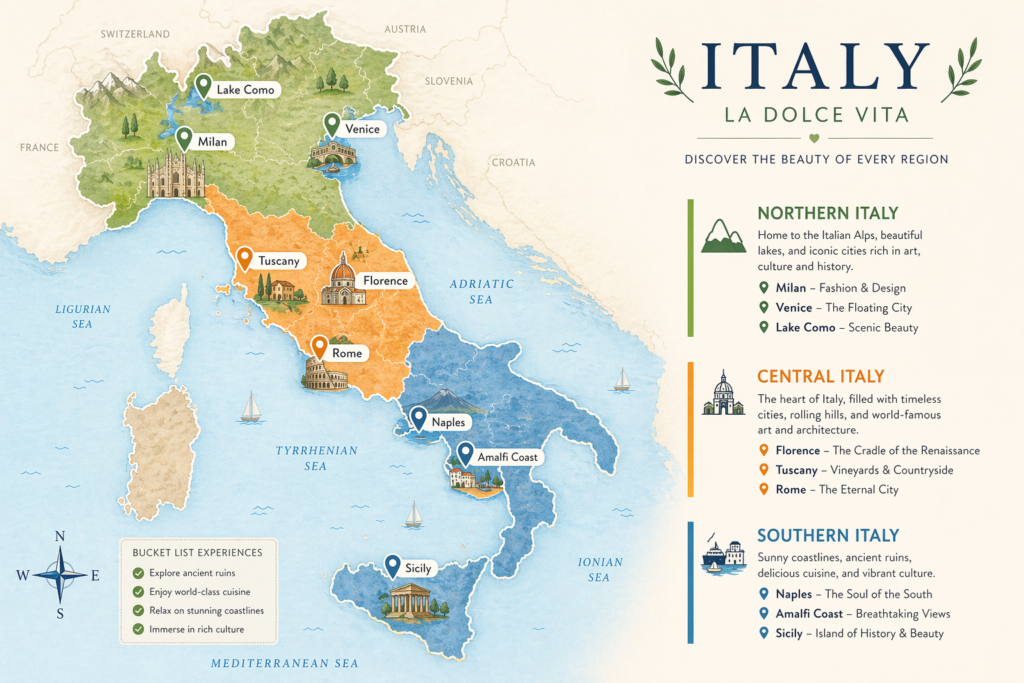
Before you start booking flights or hotels, you need to understand the Italy map because the geography fundamentally changes your planning. Italy is a 1,200-kilometer-long boot-shaped peninsula, which means the distances between regions are more significant than most travelers expect.
- Northern Italy: Milan, Venice, Lake Como, Verona, the Dolomites — efficient rail connections, cosmopolitan energy, dramatic alpine scenery
- Central Italy: Rome, Florence, Tuscany, Umbria — the cultural heartland, most visited region, world-class art and history
- Southern Italy: Naples, Amalfi Coast, Sicily, Puglia, Calabria — slower pace, more authentic, dramatically beautiful, and significantly cheaper
Understanding this north-south dynamic is critical. Many travelers make the mistake of combining Venice and the Amalfi Coast in the same short trip — they’re essentially opposite ends of the country.
Reading an Italy Map for Smart Trip Planning
Here’s how I personally read an Italy map when planning a trip. First, I identify my entry and exit airports. Then I draw a logical geographic arc between the destinations I want to visit. Italy’s train network — operated by Trenitalia and Italo — is excellent in the north and center, but thins out considerably in the south. Therefore, for southern Italy travel, I factor in car rentals or local buses.
Map of Italy regions to bookmark: the country is divided into 20 official regions. For travel purposes, you only really need to think in three macro zones: north, center, and south. Italy maps for travel planning are widely available via Google Maps and specific tools I’ll mention later.
Region-Based Travel Strategy (Avoiding Wasted Time)
The most efficient Italy travel strategy I’ve developed over the years is region-clustering. Rather than bouncing between distant cities, I cluster destinations within a single region per trip segment. For example: Milan → Lake Como → Verona → Venice is a natural northern arc. Rome → Florence → Siena → Cinque Terre covers central Italy efficiently. Naples → Pompeii → Amalfi Coast → Sicily works as a southern immersion.
Strategy: Pick no more than 2 regions per 10-day trip. Attempting all three zones in a single trip leads to exhaustion, not exploration.
What Actually Works in 2026: Best Places to Visit in Italy by Region
Northern Italy Highlights (Efficiency + Scenery)
Milan, Lake Como, Venice — these three places form the backbone of northern Italy travel and, in my experience, they work beautifully together because they’re each completely different in character.
Milan is the one northern Italian city most travelers underestimate. Yes, it’s Italy’s fashion and financial capital, but underneath that glossy surface sits a city with extraordinary art — the Last Supper alone is worth a visit. However, don’t spend more than 2 days here on a first visit.
Lake Como is where I tell every traveler to slow down. The lake’s dramatic pre-Alpine setting, the elegant villas, the ferry rides between towns like Bellagio and Varenna — this is Italy operating at full romance. For travelers who appreciate quiet luxury, I’d direct you toward our guide on the
For travelers who appreciate scenery paired with luxury, my best luxury travel destinations in Europe guide covers Lake Como in depth alongside other elite European experiences.
Venice, meanwhile, is genuinely unlike anywhere else on Earth. However, it’s best visited in November through March when the cruise ship crowds evaporate and the city reclaims its ancient, melancholy magic. The iconic canals, the Grand Canal at dawn, a cicchetti-and-Aperol spritz evening at a bacaro — these experiences make northern Italy unforgettable.
Central Italy Highlights (Culture + History)
Rome, Florence, and Tuscany — this trio is the heartbeat of Italian civilization and, for most travelers, the places in Italy that define the entire country.
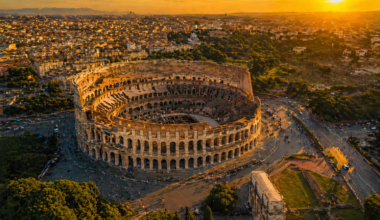
Rome deserves a minimum of 3–4 days. The Colosseum, the Vatican, the Pantheon, the Trevi Fountain — but also the lesser-visited Aventine Hill, the Trastevere neighborhood at night, the Jewish Ghetto. Rome is a city of infinite layers, and the more time you give it, the more it reveals.
Florence in 2–3 days covers the Uffizi, the Accademia (Michelangelo’s David), the Ponte Vecchio, and the Oltrarno neighborhood — which is where I personally spend most of my time because the artisan workshops and local restaurants there represent Florence before the tourist economy took over.
Tuscany as a day-trip or extended stay from Florence is one of the great Italy experiences. The drive through the Val d’Orcia region — especially in April and May when the rolling hills are green and the cypress trees cast long shadows in the late afternoon light — is genuinely one of the most beautiful drives in the world.
Southern Italy Highlights (Relaxation + Coastal Beauty)
Southern Italy is where I tell repeat visitors to go. Most first-time travelers skip it entirely and come back for it later — inevitably saying it was their favorite part of Italy. The best southern places to visit in Italy include Naples, Pompeii, the Amalfi Coast, Matera, and Sicily.
Naples is raw, loud, and completely authentic. The pizza here — I’m talking about a Margherita from a wood-fired oven in the Spaccanapoli neighborhood — is the best I’ve had anywhere in the world, and I don’t say that lightly. Naples is also your gateway to Pompeii (45 minutes by local train) and the Amalfi Coast.
Sicily is arguably Italy’s most diverse single destination. Ancient Greek temples in Agrigento, Baroque Palermo, the volcanic drama of Mount Etna, and some of the Mediterranean’s best beaches. For solo travelers looking to explore independently, our guide on
For independent travelers ready to explore southern Italy solo, check out my solo travel Europe destinations guide for practical tips that apply perfectly to the southern Italian experience.
Amalfi Coast Deep Dive (Why It’s One of Italy’s Top Experiences)
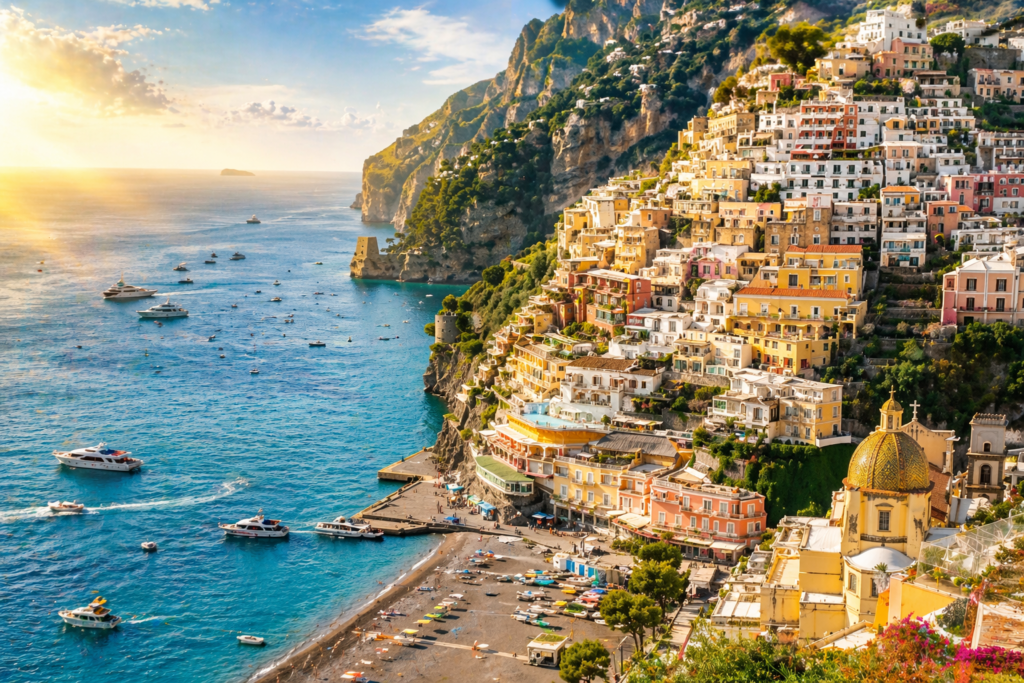
In Italian, the Amalfi Coast is known as the Costiera Amalfitana — and that name carries the full weight of what you’re about to experience. I’d argue the Amalfi Coast is the single most visually dramatic coastline in Europe, and I’ve driven or walked significant stretches of the French Riviera, the Algarve, and the Dalmatian Coast for comparison.
What makes Amalfi Italy unique isn’t just the view — it’s the verticality. The villages of Positano, Ravello, and Amalfi itself are literally built into the cliff face. Walking the streets means climbing stairs constantly, terraced gardens hang over the sea, and lemon groves scent the air. It’s a sensory experience unlike anything else in Italy.
When to visit: May to early June and September are the sweet spots. July and August are brutally crowded and hot — the famous coastal road becomes a slow-moving parking lot, and hotel prices double. However, even in peak season, staying in Ravello (higher up, away from the beach crowds) gives you a dramatically quieter experience.
How to get there: From Naples, take the Circumvesuviana train to Sorrento, then a ferry or SITA bus along the coast. I strongly recommend the ferry approach — arriving by sea with the full panoramic view of the cliffs above you is the proper way to first lay eyes on the Amalfi Coast.
Best Places to Visit in Italy for First-Time Travelers
Ideal First-Time Itinerary (Simple and Efficient Route)
The best places to visit in Italy for the first time follow a very clear geographic logic: fly into Rome, spend 3–4 days there, take the high-speed train to Florence (1.5 hours), spend 2–3 days in Florence and Tuscany, then either continue north to Venice or head south to Naples and the Amalfi Coast.
Here’s my recommended 9-day first-timer framework:
- Days 1–3: Rome (Colosseum, Vatican, Trastevere, Campo de’ Fiori)
- Day 4: Day trip to Pompeii or Ostia Antica from Rome
- Days 5–6: Florence (Uffizi, Accademia, Oltrarno, Chianti wine tasting)
- Day 7: Day trip to Siena or San Gimignano from Florence
- Days 8–9: Venice (Grand Canal, Rialto, evening cicchetti tour)
This route keeps you on the excellent high-speed rail network and avoids the logistical complexity of the south — which is better saved for a return visit.
Top 3 Places That Deliver the Full Italy Experience
For first timers, the top 3 places to visit in Italy for first timers that collectively deliver the most complete Italian experience are:
- Rome — Ancient world, modern chaos, incredible food. Nothing else matches it for raw impact.
- Florence — Art, beauty, and the gateway to Tuscany. You leave feeling genuinely cultured.
- Amalfi Coast — Natural drama and coastal beauty that reminds you why Italy is so romantically iconic.
I’ve recommended this combination to dozens of travelers, and it consistently generates the most enthusiastic responses when they return. These three experiences cover history, culture, and natural beauty in a way that no other country clusters so neatly.
Common Mistakes First-Time Travelers Make
In my experience guiding people’s Italy planning, these are the most painful mistakes I see:
- Booking every major museum in advance (good) but forgetting to book the Vatican separately (very bad)
- Assuming Venice is just a day trip — it needs at minimum 2 nights to experience it properly
- Staying in a hotel directly on the Amalfi coastal road — the noise and traffic make it a poor sleep
- Eating at restaurants immediately adjacent to major tourist attractions — the price-to-quality ratio is almost always terrible
- Underestimating how physically demanding Italy is — there is a lot of walking, stair-climbing, and cobblestone navigation
Best Places to Visit in Italy by Month (Smart Seasonal Planning)
Spring (April–May): Best Balance of Weather + Crowds
Best places to visit in Italy in April and best places to visit in Italy in May share one enormous advantage: the weather is genuinely perfect — warm but not scorching, green landscapes everywhere, and crowds that are significant but not yet at summer levels.
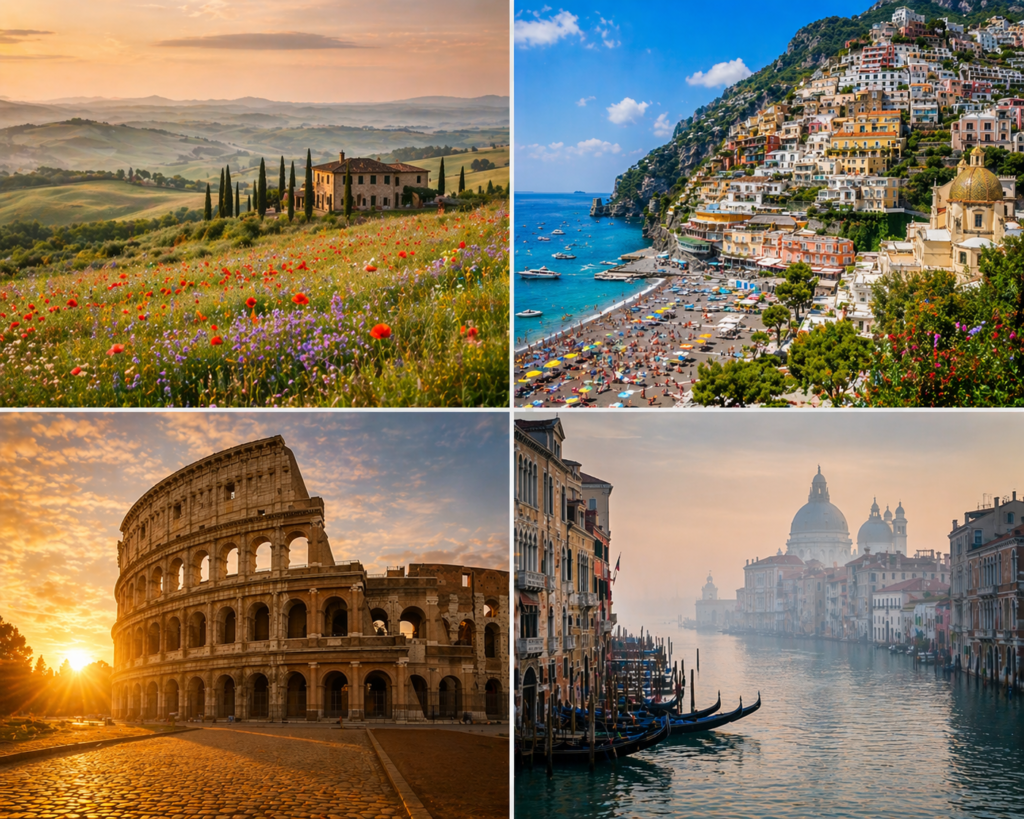
In April, Tuscany is at its most visually stunning — wildflowers, fresh green hills, and the smell of rain on old stone. Florence in April sees temperatures around 18–22°C. The Amalfi Coast in May is, in my opinion, the single best time to visit that coastline — warm enough to sit on terraces, cool enough to walk without sweating through your shirt.
Easter week (Settimana Santa) is an exception — prices spike and crowds surge. If your April trip falls over Easter, I’d recommend booking significantly in advance or shifting your dates by a week.
Summer (June): Peak Season Strategy Without Overwhelm
Best places to visit in Italy in June is arguably the most popular search for Italian travel timing — and for good reason. June gives you the last gasp of manageable summer crowds before the school holidays fully kick in July and August.
My June strategy: visit cities in the morning (before 11am), retreat to your accommodation or a shaded restaurant during the midday heat, and re-emerge in the late afternoon and evening when Italian cities genuinely come alive. Evening Rome in June — the golden light, the outdoor restaurants, the ambient warmth — is one of travel’s great pleasures.
For coastal destinations in June, the Amalfi Coast and Cinque Terre are busy but manageable. The sea temperature is perfect for swimming. However, if you’re going to Sicily in June, book very early — it’s becoming increasingly popular and accommodation fills fast.
Fall (September–October): Best Overall Travel Experience
Best places to visit in Italy in September and best places to visit in Italy in October represent — in my unambiguous opinion — the single best time to visit Italy. The summer crowds have gone, the temperatures have dropped to comfortable levels (20–26°C), and the harvest season transforms the countryside and the food.
September in Tuscany during the grape harvest (vendemmia) is extraordinary. October is truffle season in Umbria and Piedmont. The Amalfi Coast in September is ideal — warm sea, thinning crowds, and golden afternoon light on those famous cliffs.
Venice in October begins its off-season transition. The acqua alta (tidal flooding) can start appearing, but it’s manageable with waterproof boots — and frankly adds to Venice’s dramatic, melancholy atmosphere in a way I find completely compelling.
Winter (November–December): Budget + Unique Experiences
Best places to visit in Italy in November and best places to visit in Italy in December are genuinely underrated. The crowds at major attractions are dramatically reduced, prices drop significantly, and you get an authenticity that summer simply can’t offer.
Rome in November is one of my favorite city experiences in all of Europe. The Vatican Museums without a crush of tourists. The Colosseum on a grey morning with mist rising from the surrounding ruins. Christmas markets appear across northern Italy in December — particularly in Bolzano in the South Tyrol region, which runs one of the most beautiful alpine Christmas markets on the continent.
Venice in winter is extraordinary — foggy, atmospheric, and blissfully quiet. The downside is that some coastal destinations (Cinque Terre, Amalfi) feel closed and sleepy in deep winter, so adjust your expectations accordingly.
Best Places Based on Travel Style
Best Places in Italy for Couples (Romantic Destinations)
When people ask me the best places to go in Italy for couples, I always start with the Amalfi Coast — specifically Positano and Ravello. There is something about the combination of vertical cliffs, pastel-colored buildings, candlelit dinners on vine-covered terraces, and the sound of the sea below that creates a genuinely romantic atmosphere that’s difficult to manufacture elsewhere.
Venice, despite being heavily touristed, retains its romantic power — particularly in the late evening when the day-trippers have left. A gondola ride after dark along the smaller canals (not the Grand Canal) is a cliché that actually delivers. Tuscany for couples who prefer countryside romance: agriturismo stays in converted farmhouses, private wine tastings, and long lunches in hilltop medieval towns.
Best Places to Visit in Italy with Kids (Stress-Free Picks)
Best places to visit in Italy with kids requires a different calculation than adult-focused travel. In my experience, Rome works exceptionally well with children — the Colosseum is genuinely exciting for kids who’ve grown up with any exposure to Roman history, and the city’s gelato culture is built-in bribery.
Lake Garda is probably the single best Italian destination specifically for families — the lake provides swimming, water sports, and the Gardaland theme park. It’s not culturally deep, but it’s reliably enjoyable for every age group. Avoid Venice with very young children — the labyrinthine streets, the lack of vehicles, and the omnipresent water can be stressful rather than magical with toddlers.
Best Places for Food Lovers (Authentic Italian Experience)
If Italy’s food is your primary motivation — and I would argue it should always be at least secondary — the best places to visit in Italy for food are not the ones that top the tourism charts.
- Bologna: Italy’s gastronomic capital. Ragù Bolognese here is not what you’ve had at home — it’s a revelation. Mortadella, tortellini, tagliatelle al ragù. The covered market Quadrilatero is a pilgrimag for food lovers.
- Naples: Pizza, sfogliatelle pastries, espresso standing at a bar. The street food culture around Spaccanapoli is extraordinary.
- Sicily: Arancini, pasta alla Norma, cannoli, fresh swordfish. The Arab-Norman culinary heritage creates flavor profiles unlike anywhere else in Italy.
- Modena: Aceto Balsamico Tradizionale, Parmigiano Reggiano, and Massimo Bottura’s Osteria Francescana — the world’s best restaurant — are all within reach.
Best Budget-Friendly Destinations in Italy
Best places to visit in Italy cheap require moving away from the top-tier tourist circuit. In my experience, the best value for money in Italy consistently comes from the south and the lesser-visited inland regions:
- Naples: Excellent food, rich history, great accommodation for a fraction of Rome’s prices
- Puglia (Lecce, Alberobello, Ostuni): Charming, beautiful, dramatically undervisited and affordable
- Sicily: Cheaper than almost anywhere in northern or central Italy with genuinely world-class experiences
- Matera: A UNESCO World Heritage Site cave city that remains one of Europe’s best-kept travel secrets
A practical note on budget Italy travel: eating at the bar (standing up, counter service) for breakfast and lunch, and avoiding restaurants with photo menus, will dramatically reduce your food spend without compromising quality — in fact, it usually improves it.
Step-by-Step Framework to Plan Your Italy Trip
Step 1: Choose Regions Based on Time (7–14 Day Planning)
The first decision in any Italy trip plan is also the most important: which region or regions will anchor your trip? Here’s the framework I use based on trip length:
| Trip Length | Recommended Regions | Key Cities |
| 7 days | Central Italy only | Rome + Florence + Tuscany day trip |
| 10 days | Central + one addition | Rome + Florence + Venice OR Amalfi Coast |
| 12 days | Central + South | Rome + Naples + Amalfi Coast + Sicily |
| 14 days | Two full regions | Northern arc + Central OR Central + Southern deep dive |
Step 2: Select 2–4 Cities (Avoid Overplanning)
Once you’ve chosen your region(s), select your anchor cities. I recommend no more than 4 cities for any trip under 14 days — and for 7–10 day trips, 2–3 cities is the sweet spot. The temptation is always to add more — just a quick stop in Siena, just a day in Verona — but these half-days rarely deliver the depth that the destination deserves.
Each city should get at minimum 2 nights (ideally 3). Anything less and you’re essentially doing an airport transit with sightseeing.
Step 3: Optimize Travel Routes Using the Italy Map
Plot your chosen cities on an Italy map and check the train journey times between them. Italy’s high-speed trains (Frecciarossa) make the Rome–Florence–Venice corridor extremely efficient. However, the moment you move off the main rail spine — into Puglia, Sicily, the Amalfi Coast — travel times balloon and you need to factor in buses, ferries, or car rentals.
The golden rule: never backtrack. Design your route as a one-way arc or loop so that each leg of the journey is moving forward toward your exit point.
Step 4: Balance Landmarks, Experiences, and Relaxation
The most common planning mistake I see is filling every hour with landmarks and leaving no room for the unplanned moments that actually define great travel. Therefore, I always build in what I call ‘slow days’ — mornings with no agenda, afternoons wandering without a map, evenings discovering a neighborhood restaurant because you followed your nose down a side street.
Italy rewards slowness more than almost any destination I know. The travelers who come back most satisfied are rarely the ones who checked off the most boxes.
Rule of thumb: For every 2 structured landmark days, plan 1 slow, unscheduled day. Your Italy experience will be dramatically richer for it.
Real Travel Scenarios (What Actually Works)
7-Day Italy Trip Example (Fast-Paced First Visit)
This is the itinerary I recommend when someone has exactly one week and is visiting Italy for the first time. It’s efficient, geographically logical, and covers the three most essential Italian experiences:
- Day 1: Arrive in Rome. Check in, evening walk around the historic center (Campo de’ Fiori, Pantheon area)
- Day 2: Rome — Colosseum, Roman Forum, Palatine Hill in the morning; Trastevere in the evening
- Day 3: Rome — Vatican Museums + St. Peter’s Basilica (booked well in advance)
- Day 4: High-speed train to Florence (1.5 hrs). Afternoon: Uffizi Gallery. Evening: Oltrarno neighborhood
- Day 5: Florence — Accademia (David), Ponte Vecchio, day trip to Siena or Chianti
- Day 6: Train to Venice (2 hrs). Afternoon: Grand Canal, Rialto Market, evening cicchetti tour
- Day 7: Venice — Piazza San Marco before 9am (before crowds), Doge’s Palace, depart
10-Day Balanced Italy Itinerary
With 10 days, you can add meaningful depth to the 7-day framework. My recommendation is to extend Florence by a day and add a proper southern Italy experience:
- Days 1–3: Rome (same as above, plus a day for lesser-visited neighborhoods like Testaccio and Pigneto)
- Days 4–5: Florence with a full Tuscany day trip (Val d’Orcia or Chianti wine country by car)
- Day 6: Train to Naples (70 min from Rome). Afternoon Naples street food tour, evening in Spaccanapoli
- Day 7: Pompeii day trip, afternoon return to Naples
- Days 8–9: Amalfi Coast (base in Positano or Ravello — ferry/bus between towns)
- Day 10: Return to Rome via Naples for departure
14-Day Deep Exploration Plan
Two weeks allows you to actually experience two distinct regions of Italy at a reasonable pace. Here’s the itinerary structure I consistently recommend:
- Days 1–4: Rome + day trips (Pompeii, Orvieto, or Castelli Romani)
- Days 5–7: Florence + Tuscany (including an agriturismo night if budget allows)
- Days 8–9: Cinque Terre (base in Monterosso al Mare — the most beach-friendly village)
- Days 10–11: Milan (city exploration + day trip to Lake Como)
- Days 12–13: Venice
- Day 14: Departure from Venice or back to Rome
This 14-day route follows the natural north-south geographic arc and uses the high-speed rail network efficiently throughout.
Italy vs Spain: Where Should You Travel?
Key Differences in Experience (Culture, Food, Cost)
I get this question constantly, and it’s genuinely one of the best travel decisions a new European explorer faces. Both countries are extraordinary, but they’re extraordinary in very different ways. Let me give you an honest comparison based on my personal experience traveling extensively in both:
| Factor | Italy | Spain |
| History & Architecture | Ancient Rome, Renaissance, Baroque | Moorish, Gothic, modernist (Gaudí) |
| Food Culture | Regional, ingredient-driven, strict traditions | Tapas culture, more flexible, diverse |
| Cost | Moderate (cheaper in south) | Slightly cheaper overall |
| Coastline | Amalfi Coast, Sicily, Sardinia | Costa Brava, Balearics, Andalusia |
| Nightlife | Aperitivo culture, late dinners | Much later, more party-focused |
| Best Cities | Rome, Florence, Venice | Barcelona, Madrid, Seville |
| Ease of Travel | Excellent trains in north/center | Excellent nationwide rail network |
When Italy Is the Better Choice
Choose Italy over Spain when history, art, and UNESCO-level cultural experiences are your primary motivation. Italy’s density of world-class heritage — more UNESCO World Heritage Sites than any other country — is simply unmatched. Furthermore, if authentic regional food culture is your driving interest, Italy’s hyper-regional cuisine traditions make Spain look relatively homogenous in comparison.
Also choose Italy when you want coastline with dramatic topography — the Amalfi Coast and Sicily deliver a combination of mountains, sea, and culture that Spain’s flatter coastal regions generally can’t match.
If you’re weighing up the best places in Spain versus Italy, we also have a dedicated European destinations guide covering solo travel Europe destinations which compares both countries for independent travelers.
When Spain Might Be a Better Fit
Choose Spain when budget is a primary concern (it’s marginally cheaper across the board), when modern architecture interests you (Gaudí’s Barcelona is a genre unto itself), or when you want a more relaxed, flexible food culture where you can eat well without obsessing over regional rules. Spain’s best places to visit — Madrid, Barcelona, Seville, Granada — also have excellent infrastructure and are slightly easier to navigate for first-time European travelers.
Common Mistakes That Kill Your Italy Experience
Trying to Visit Too Many Cities
This is the number one Italy travel mistake and I’ve made it myself early in my traveling career. The fantasy of seeing Rome, Florence, Venice, the Amalfi Coast, Sicily, Milan, and Cinque Terre in 10 days is just that — a fantasy. In reality, you’d be spending a full 30–40% of your trip on trains, checking in and out of hotels, and arriving in each place too tired to actually engage with it.
More is not more in Italy. Less is considerably, dramatically more.
Ignoring Regional Differences
Italy is not a monolithic culture. The north and the south are so different — in food, in pace, in architecture, in economic development, in dialect — that experienced Italians themselves sometimes describe visiting the other end of the country as going abroad. Therefore, treating Italy as one homogenous entity and expecting everywhere to be like Rome is a recipe for disappointment.
Embrace the regional differences. They’re Italy’s greatest hidden asset.
Traveling Without Seasonal Awareness
I’ve met travelers who booked an Amalfi Coast trip in mid-August (brutal heat, maximum crowds, inflated prices), and others who showed up to Cinque Terre in January expecting the charming fishing villages to be open and bustling. Italy is an intensely seasonal country — the experience changes fundamentally depending on when you visit, and most travel guides gloss over just how significant this difference actually is.
Underestimating Travel Time Between Locations
Italy on a map looks compact. Italy in practice is much larger than it appears. The Rome-to-Amalfi Coast journey, for example, takes a minimum of 3–4 hours via public transport (train to Naples + bus/ferry). The Venice-to-Amalfi overland journey is the better part of an entire day. Always add a time buffer and never book a flight departure on the same day as a long inter-city journey.
Essential Travel Tips Most Guides Miss
Can You Drink Tap Water in Italy?
Yes — and this surprises a lot of travelers. Tap water in Italy is perfectly safe to drink in virtually all cities and towns, and is actually quite good quality. The famous nasoni (small nose-shaped public fountains) throughout Rome provide continuously flowing cold drinking water from the city’s ancient aqueduct system. I drink from them every visit.
The one caveat: in very rural or remote southern areas, it’s worth checking locally. However, in all major cities — Rome, Florence, Milan, Venice, Naples — tap water is safe, clean, and tasty. Therefore, buy a reusable water bottle and refill it at fountains — it saves money and reduces plastic waste.
Transportation Strategy (Train vs Car)
For northern and central Italy, trains are always my preferred choice. The Frecciarossa high-speed service between Rome and Florence takes 1.5 hours — the equivalent drive is 3+ hours plus parking misery. However, for Tuscany’s countryside, Sicily, Puglia, and the southern coastal regions, a rental car opens up the experience significantly.
My simple framework: Use trains for major city-to-city moves. Use a car for anywhere south of Naples or in rural Tuscany and Umbria. This combination gives you the best of both Italy’s excellent rail network and its beautiful rural driving roads.
Booking Strategy (Avoiding Tourist Traps)
- Book Vatican Museums and the Colosseum weeks in advance — skip-the-line access is worth every extra euro
- Avoid restaurants with translated menus displayed outside — they’re designed for tourists who won’t return
- Eat where locals eat: look for no-menu chalkboard specials (piatto del giorno), packed lunch crowds of office workers, and restaurants on streets without souvenir shops
- Book your Amalfi Coast accommodation before anywhere else in your itinerary — supply is extremely limited relative to demand
- For train tickets, book the high-speed Frecciarossa or Italo services at least 2–3 weeks in advance for the best fares
Tools & Resources to Plan Your Italy Trip
Best Map Tools and Route Planners
- Google Maps: Excellent for general Italy map navigation, walking routes, and transit times between cities
- Rome2Rio: Best tool for comparing train vs bus vs ferry travel times and costs across Italy
- Komoot: Ideal for planning hiking routes in Cinque Terre, the Amalfi Coast trail, and Sicily’s Etna trails
- Trenitalia and Italo apps: Direct booking for Italy’s high-speed train network with the best fares
Booking Platforms That Actually Save Money
- Booking.com: Widest selection for Italy, particularly for smaller hotels and B&Bs in southern Italy
- Airbnb: Best for agriturismo-style stays in Tuscany and long-stay apartment rentals in cities
- GetYourGuide and Viator: For pre-booking Vatican Museums, Colosseum, and Uffizi timed entry tickets
- Omio: Excellent for comparing and booking train tickets across multiple Italian operators in one interface
Travel Apps That Improve Your Experience
- Google Translate (with Italian downloaded for offline use): Essential for menus and signage in rural areas
- Maps.me: Offline maps that work without mobile data — invaluable in remote coastal areas
- TripAdvisor (with skepticism): Useful for restaurant verification but filter ruthlessly by recency and reviewer nationality
- Rick Steves Audio Europe: Free audio guides for Rome, Florence, and Venice that I genuinely recommend
Quick Checklist Before You Visit Italy
Destination Selection Checklist
- Identified my trip length and matched it to appropriate number of regions
- Selected 2–4 anchor cities based on my travel style and interests
- Checked geographic logic — no unnecessary backtracking on the Italy map
- Allocated minimum 2 nights per city (3 for Rome, Florence, Venice)
- Researched at least one ‘slow day’ per 3-day block
Seasonal Planning Checklist
- Confirmed travel dates and checked seasonal crowd levels for each destination
- Verified which attractions are open (some coastal towns partially close in winter)
- Adjusted Amalfi Coast plans if traveling in July–August (consider arriving early morning)
- Checked for local festivals or events that might affect accommodation availability
- Booked Amalfi Coast and Cinque Terre accommodation first — these sell out earliest
Budget & Booking Checklist
- Vatican Museums + Colosseum: booked in advance with timed entry
- Uffizi Gallery Florence: pre-booked (long queues without reservation)
- High-speed train tickets: purchased on Trenitalia or Italo for best fares
- Travel insurance: confirmed and active for the full trip duration
- Credit card with no foreign transaction fees: essential for Italy’s card-friendly modern economy
- Reusable water bottle: packed — Italy’s tap water and public fountains are excellent
FAQ (Based on Real Search Questions)
Which part of Italy is most beautiful?
In my personal experience, southern Italy — specifically the Amalfi Coast and Sicily — offers the most visually dramatic beauty in terms of natural landscapes. However, for architectural and cultural beauty, central Italy (Tuscany, Rome, Florence) is arguably unmatched. The honest answer is that every region of Italy is beautiful in a different way, and the ‘most beautiful’ is ultimately a matter of what kind of beauty you’re seeking.
What is the top 3 destination in Italy?
The top 3 destinations in Italy based on traveler volume, experience, and historical significance are: Rome (the Eternal City), Florence (the Renaissance capital), and Venice (the floating city). However, for travelers who prioritize natural beauty over urban culture, I would substitute Venice with the Amalfi Coast.
What is the Big 3 of Italy?
The Big 3 of Italy refers to Rome, Florence, and Venice — the three cities that most comprehensively represent Italy’s historical, artistic, and architectural identity. Rome represents ancient civilization and the Catholic world. Florence represents the Renaissance and its continuing cultural legacy. Venice represents the Republic of Venice’s maritime empire and its unique position as a city built on water.
Can I drink tap water in Italy?
Yes, absolutely. Tap water in Italy is safe to drink in all major cities and most towns throughout the country. Italy’s public drinking fountains — particularly the famous nasoni in Rome — provide continuously running cold drinking water from ancient aqueduct systems. I drink from them on every visit without any issues. However, in very remote rural areas, it’s worth asking locally just to confirm.
Final Action Plan: How to Choose Your Perfect Italy Itinerary
3 Simple Steps to Finalize Your Trip
After everything I’ve laid out in this guide, here’s the simplest possible action framework for finalizing your Italy trip:
- Choose your trip length and match it to 1–2 regions using the table earlier in this guide
- Select 2–4 anchor cities that align with your primary travel motivation (culture, food, nature, budget)
- Book in this order: flights → Amalfi/Cinque Terre accommodation → major museum tickets → trains → remaining hotels
That booking sequence matters. Coastal accommodation and museum access are the two biggest sources of Italy travel disappointment when left too late.
How to Avoid Overplanning
Here’s something I tell every person I help plan an Italy trip: the version of Italy you’ll treasure most won’t be on your itinerary. It’ll be the afternoon you got lost in Trastevere and ended up at a neighborhood restaurant where nobody spoke English and the pasta was extraordinary. It’ll be the morning in Venice when you wandered away from the tourist routes and found yourself completely alone in a campo with pigeons and old men playing cards.
Plan the structure. Leave space for the rest.
Turning This Guide into Your Actual Travel Plan
Here’s my recommended action sequence to move from reading this guide to having an actual Italy trip booked:
- Decide your dates and trip length today
- Use the seasonal planning section to confirm your timing is optimal
- Use the regional breakdown to select your anchor destinations
- Use the scenario itineraries (7, 10, or 14 days) as your base template
- Customize based on your travel style section (food, couples, budget, kids)
- Run through the three checklists before booking anything
If you’re planning a broader European adventure beyond Italy, our guides on best family vacation destinations in Europe and best luxury travel destinations in Europe will give you the wider context to make Italy part of a spectacular multi-country trip.
Conclusion
Italy is, without question, one of the most rewarding countries on earth to travel through. I’ve been back more times than I planned, stayed longer than I intended, and spent more money than I budgeted — and I have never once regretted any of it. The best places to visit in Italy are genuinely best experienced rather than simply seen, and the difference between the two is everything.
Whether you’re heading to the Amalfi Coast for the first time, returning to dig deeper into Sicily, navigating an Italy map for a complex multi-city route, or simply trying to figure out which month to go — I hope this guide gives you the confidence and clarity to plan a trip that actually delivers.
Italy rewards the prepared traveler. Use this guide. Plan thoughtfully. And then let Italy do the rest.
Have a question or a destination I didn’t cover? Let me know in the comments — I read and respond to every one.