Introduction
I’ve planned more Europe trips than I can count — for myself, for friends, and for readers who’ve reached out with that same overwhelmed look in their eyes. And every single time, the biggest problem isn’t money, it isn’t timing, and it certainly isn’t a lack of beautiful places to visit. The biggest problem is that most people have no idea where to actually start when they want to plan a trip to Europe.
Europe is enormous. It spans dozens of countries, hundreds of cities, multiple languages, and more cultural layers than any one trip could possibly capture. That’s exactly why so many people either end up with an overloaded itinerary that leaves them exhausted — or they spend weeks just researching and never actually book anything.
Here’s what I’ve learned: planning a Europe trip doesn’t have to be complicated. It just needs a clear framework, the right tools, and an honest look at what you actually want from the experience.
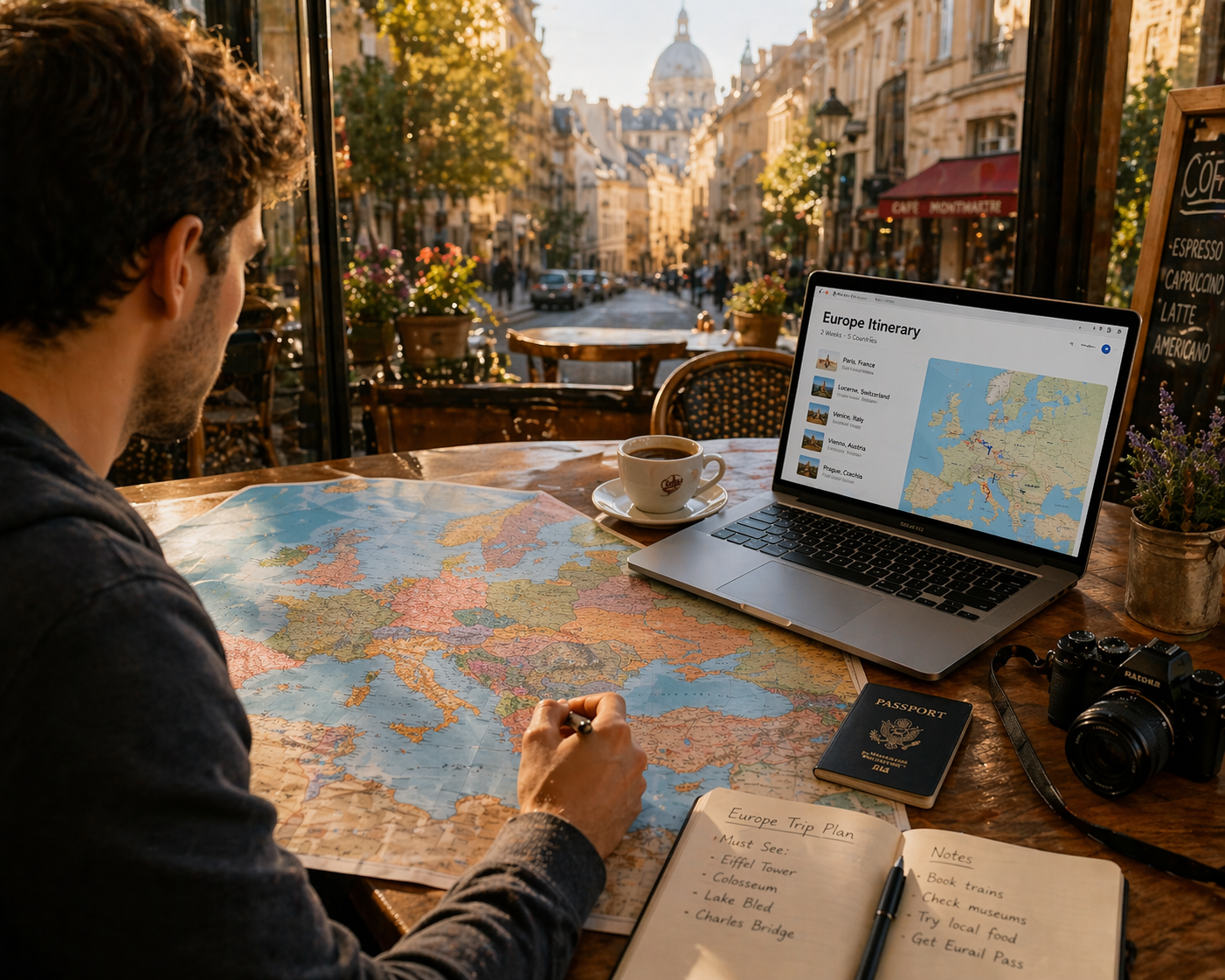
Whether you’re looking to plan a trip to Europe for 10 days on a tight budget, building a two-week Europe trip itinerary across five countries, or simply trying to figure out where to start with a multi-city Europe trip planner — this guide covers it all. I’ll walk you through every step, share real examples, highlight the mistakes to avoid, and give you a working action plan by the end.
Let’s get into it.
Quick Answer — What Actually Works When You Plan a Trip to Europe
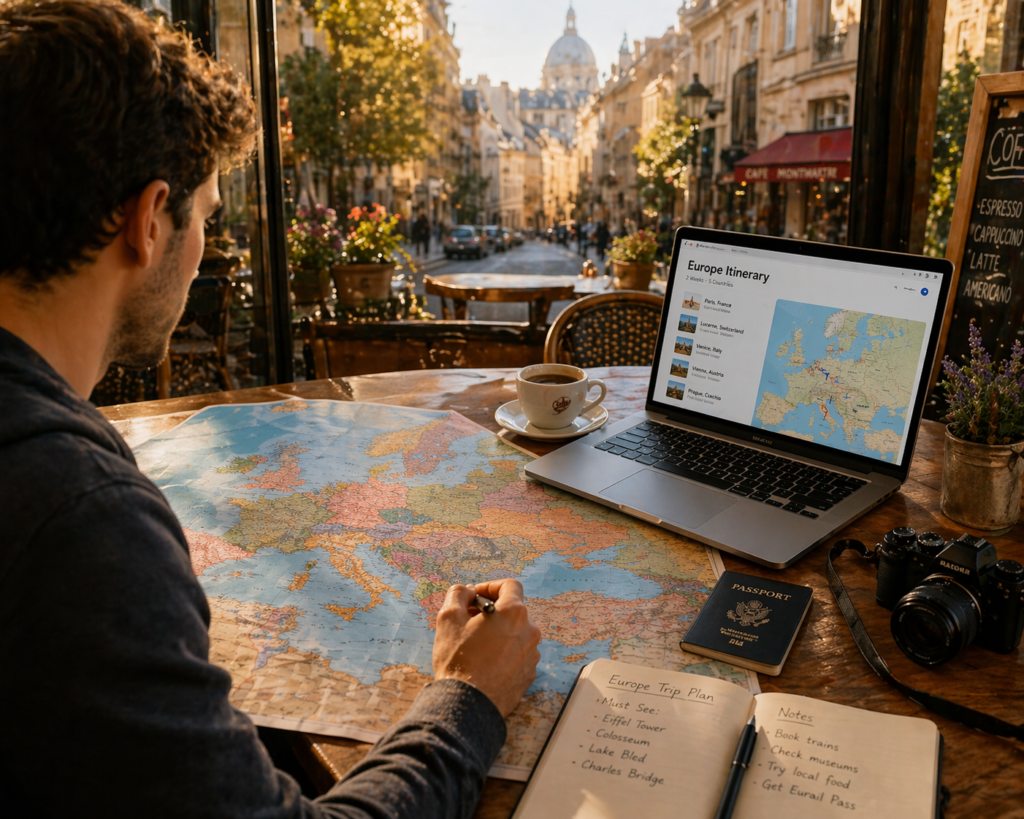
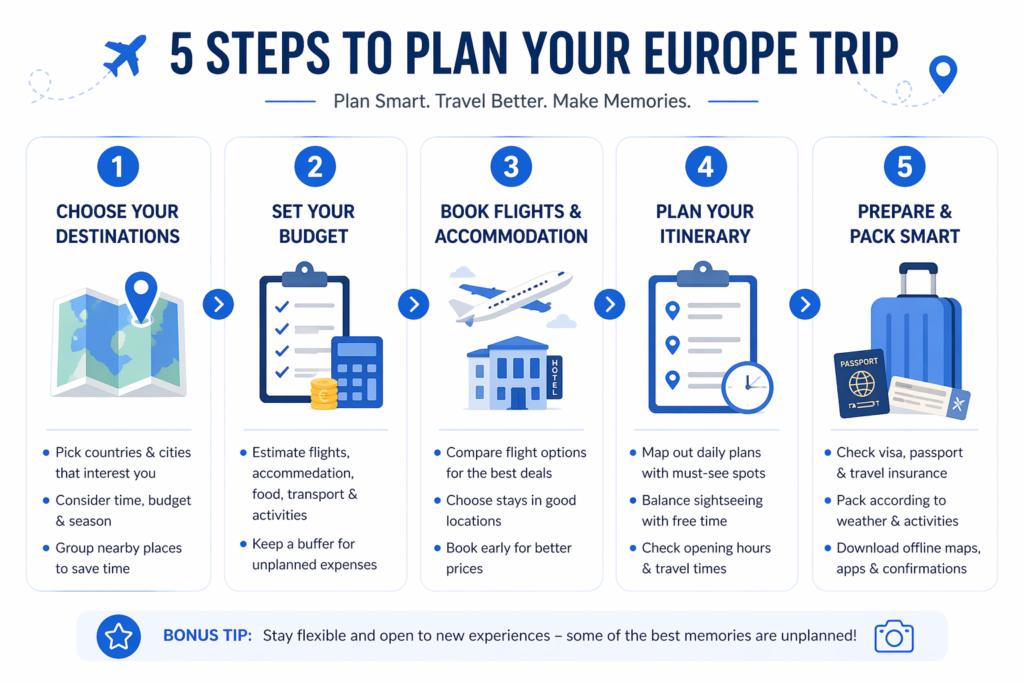
If you’re short on time and need the core answer fast, here it is: the most effective way to plan a trip to Europe is by working through a five-step framework — starting with your travel goals and ending with locking in your transportation and accommodation. Everything else flows from that structure.
The 5-Step Planning Framework Most Travelers Miss
I’ve watched people spend weeks scrolling Instagram for inspiration and then booking random flights with no logic behind the route. That approach always leads to the same outcome — long transfers, wasted days, and a trip that feels more like a sprint than an adventure. Here’s the framework that actually works:
- Define your travel style and non-negotiables
- Choose countries based on geography, not just hype
- Set a realistic trip duration and pacing strategy
- Build a logical multi-city route that minimizes backtracking
- Book flights, stays, and transport in the right order
I’ll break each of these down in detail throughout this guide. However, the most critical step — and the one most beginners skip — is Step 2. Choosing countries based on geography rather than bucket-list hype is what separates a smooth trip from an exhausting one.
The Biggest Mistake: Trying to See Too Much Too Fast
I’ll say this plainly: the number one trip-ruiner I see is over-scheduling. Travelers want to hit Paris, Amsterdam, Berlin, Prague, Vienna, and Rome in nine days. That’s not a trip — that’s a tour bus you can’t get off.
In my experience, two to three cities per week is the sweet spot. It gives you enough time to actually experience a place, not just photograph it. Therefore, before you build any itinerary, get honest about how many places you can realistically visit without burning out. Quality over quantity — always.
Who This Europe Trip Planning Guide Is For
First-Time Travelers vs Experienced Travelers
This guide is built for both ends of the spectrum, though the approach differs significantly. If you’re planning your first Europe trip, your priority should be simplicity. Stick to two or three well-connected countries, choose cities with strong tourist infrastructure, and leave buffer days for spontaneity.
For experienced travelers, the focus shifts to optimization — smarter routing, off-peak timing, mixing rail and budget flights, and going beyond the headline destinations. In addition, experienced travelers benefit most from the multi-city Europe trip planner strategies and transport optimization sections of this guide.
Budget Travelers, Luxury Travelers, and Digital Nomads
Your travel style shapes every decision. Budget travelers need to think hard about accommodation options like hostels and home-shares, budget airlines, and shoulder-season timing. Mid-range travelers can blend quality experiences with smart savings. Luxury travelers, however, need a completely different planning approach — one centered around curated experiences rather than cost-cutting.
For inspiration on the best luxury experiences Europe has to offer, I’d recommend checking out this detailed guide on the best luxury travel destinations in Europe — it covers everything from iconic palaces to lesser-known upscale escapes that genuinely justify the splurge.
Digital nomads have their own set of priorities: solid Wi-Fi, co-working spaces, visa flexibility, and longer stays in single cities. For this group, the planning process looks less like a sprint itinerary and more like a slow-travel rotation through two or three base cities.
Step-by-Step Framework to Plan a Trip to Europe
Step 1: Define Your Travel Goals and Style
Before you open a single map or browse any flights, ask yourself three foundational questions. What do I actually want from this trip — culture, food, adventure, history, or relaxation? How fast do I want to move between places? And what is my honest budget for the full trip, not just flights?
These three answers will define every single decision that follows. For example, someone who wants a food-focused trip through Southern Europe will have a completely different route, budget, and pacing strategy than someone chasing mountain landscapes and outdoor activities. Therefore, getting clarity on this step saves hours of confusion later.
Step 2: Choose Countries Based on Geography, Not Hype
I’ve seen so many people choose their countries based on what’s trending on social media rather than what makes geographic sense. However, this creates nightmare routing — bouncing from Portugal to Poland to Greece in two weeks, for instance, means spending half your trip in airports.
Instead, cluster your countries. Western Europe cluster: France, Spain, Portugal. Central Europe cluster: Germany, Austria, Czech Republic. Southern Europe cluster: Italy, Greece, Croatia. Pick one cluster and explore it deeply. You’ll save time, money, and stress — and you’ll actually enjoy each destination.
Step 3: Decide Trip Duration (10 Days vs 2 Weeks Strategy)
Trip duration is the variable that controls everything. Here’s how I think about it: a 10-day Europe trip is perfect for two to three countries and four to five cities. A two-week Europe trip allows three to four countries and six to seven cities — but only if you’re comfortable with fast-paced travel.
In my experience, most people underestimate how much of their trip gets consumed by travel days. A 7-hour train ride is a full day gone. Therefore, build at least one buffer day into every week of travel. It makes the whole experience dramatically more enjoyable.
Step 4: Build a Logical Multi-City Route
A logical route is circular, not zig-zagged. Fly into City A, work through a connected chain of cities, and fly home from City B (or back to A if open-jaw isn’t available). For example, flying into London, moving through Paris, then Barcelona, then Rome, and flying home from Rome is a clean, logical route. Doing it in the reverse random order adds hours and unnecessary cost.
Use Google Maps in ‘trip’ mode to visually plot your cities before committing. I also recommend the multi-city Europe trip planner approach of treating each city like a chapter in a book — each one should connect naturally to the next.
Step 5: Lock Flights, Stays, and Transport Efficiently
Book in this order: international flights first, then accommodation in your first and last cities, then inter-Europe transport (trains or budget flights), then remaining accommodation. This order matters because inter-Europe transport often determines your exact arrival and departure times, which in turn determines your hotel check-in windows.
For flights, I use Google Flights and set up price alerts at least 8-12 weeks out. For trains, Trainline and Rail Europe are my go-to platforms. And for accommodation, I cross-reference Booking.com and Airbnb depending on the city and trip style.
How to Plan the Perfect Europe Itinerary (Without Overwhelm)
What Actually Works in 2026 for Itinerary Planning
The itinerary planning landscape has changed significantly over the last few years. In 2026, the most effective approach combines a pre-built template structure with real-time flexibility. Rigid day-by-day itineraries look great on paper but collapse the moment a train runs late, a museum closes unexpectedly, or you simply fall in love with a city and want to stay longer.
What works instead is what I call the ‘anchor and flex’ method. You anchor your non-negotiables — key attractions, pre-booked tickets, transportation — and leave the surrounding hours flexible. This way, you never miss the Louvre or the Colosseum, but you also don’t feel chained to a spreadsheet.
10-Day Europe Trip vs 2-Week Europe Trip Breakdown
| Category | 10-Day Europe Trip | 2-Week Europe Trip |
| Ideal Countries | 2–3 countries | 3–4 countries |
| Cities | 4–5 cities | 6–7 cities |
| Days Per City | 2–3 days avg | 2–3 days avg |
| Pace | Moderate-fast | Moderate |
| Budget Range | $2,500–$4,500 | $3,500–$6,500 |
| Best For | First-timers, limited PTO | Experienced, flexible schedules |
| Inter-City Travel | Mostly train/budget flights | Mix of train, bus, flights |
I’ve done both extensively. In my experience, the 10-day format is actually better for most travelers — especially first-timers — because it forces discipline and prevents the ‘everywhere and nowhere’ problem. Two weeks can be incredible, but only if you plan it properly.
Multi-City Europe Trip Planner Strategy (Efficient Routing)
Multi-city planning requires one principle above all else: minimize backtracking. Every time you travel back through a city you’ve already visited, you’re burning time and money on repetition. Therefore, design your route as a one-directional flow.
A practical technique I use is the ‘hub and spoke’ model for cities with high attraction density. For example, staying in Florence for three nights and doing day trips to Siena, Pisa, and the Cinque Terre keeps your accommodation base stable while maximizing what you see. This approach also reduces packing and unpacking fatigue significantly. For a deeper look at what Florence and its surroundings offer, this guide on the best places to visit in Italy (https://voyagernest.com/best-places-to-visit-in-italy/) is worth bookmarking.
How Many Cities Are Too Many? Realistic Planning Rules
Here’s my rule of thumb: never plan more than one new city every two days. Two nights minimum per city. Three nights is ideal for anything worth visiting. Anything less and you’re just collecting passport stamps, not experiences.
For a 10-day trip, that means a realistic maximum of five cities — not eight, not ten. For two weeks, seven cities is the ceiling. These numbers account for travel days, jet lag recovery, and the simple reality that things will take longer than expected.
Use Proven Templates to Plan Faster (Free and Paid)
Best Travel Itinerary Templates That Save Hours
A good itinerary planner template does three things well: it organizes your days chronologically, it captures both logistics and experiences, and it’s easy to adjust on the fly. I’ve tested dozens of both free and paid options, and here’s my honest take.
The best free travel itinerary templates right now come from three places: Google Sheets (for collaborative trip planning), Notion (for visual, flexible planning), and Trello (for a card-based, drag-and-drop approach). Each one has a different strength depending on how your brain works.
How to Use a Europe Trip Planner Template Step-by-Step
- Start with a master sheet listing all cities, dates, and accommodation
- Create a day-by-day tab for each city with morning, afternoon, and evening slots
- Add a transport sheet tracking all bookings, confirmation numbers, and times
- Include a budget tracker tab with categories for flights, stays, food, and activities
- Add a ‘What to Pack’ section tailored to each climate zone you’ll visit
This five-tab structure is the foundation of every trip planner I’ve built or recommended. It’s simple, it’s comprehensive, and it keeps everything in one place — which matters enormously when you’re navigating a foreign country with spotty Wi-Fi.
Customizing Templates for Multi-City Trips
The challenge with multi-city trips is that a basic trip itinerary template free version rarely accounts for the complexity of moving between countries. You need to layer in visa requirements (for non-EU travelers), currency changes, time zones, and local transportation options.
My recommendation: add a ‘City Profile’ section for each destination that captures the local currency, key transport hubs, local SIM card info, emergency contacts, and two or three backup attraction options for weather or closure contingencies. This takes 20 minutes per city but saves enormous stress in the field.
When to Use Digital vs Printable Travel Planners
Digital planners win in almost every scenario — they’re searchable, shareable, and update in real time. However, there’s still a case for printable travel planners: they don’t need battery, they work without signal, and some people simply think better on paper.
My personal system: digital planning during the preparation phase, printed one-page daily summaries for each travel day. This gives me the best of both worlds — the flexibility of digital with the reliability of physical backup.
Budget Planning — How Much a Europe Trip Really Costs
Real Cost Breakdown (Flights, Stay, Food, Transport)
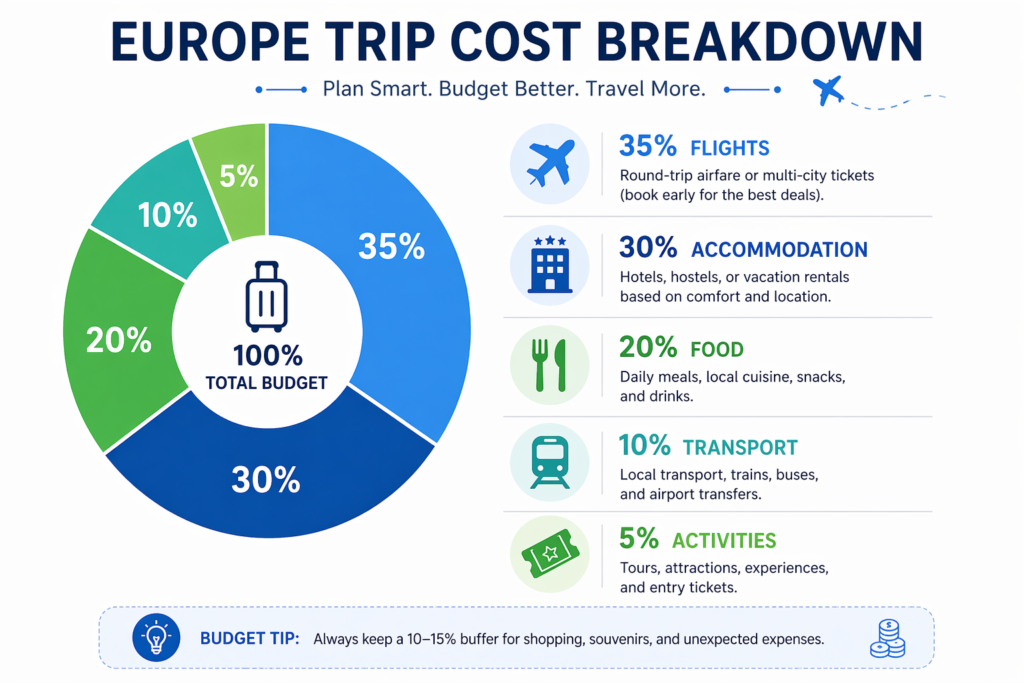
| Category | Budget Level | Mid-Range | Luxury |
| International Flights | $400–$700 | $700–$1,200 | $1,500–$4,000+ |
| Accommodation (per night) | $20–$50 (hostel) | $80–$150 (hotel) | $200–$600+ |
| Daily Food Budget | $25–$40 | $50–$90 | $100–$200+ |
| Inter-Europe Transport | $100–$250 | $250–$500 | $400–$1,000+ |
| Activities/Attractions | $50–$150 | $150–$350 | $400–$1,000+ |
| Total (2 weeks est.) | $2,200–$3,500 | $4,000–$6,500 | $8,000–$18,000+ |
How to Plan a Europe Trip on a Budget Without Sacrificing Experience
I’ve done Europe on under $60 a day and I’ve done it on over $300 a day. Both were incredible trips. The difference wasn’t the experience quality — it was the specific choices made in each category. Here are the levers that matter most for budget travelers:
- Fly into secondary airports (Beauvais instead of CDG in Paris, Stansted instead of Heathrow in London)
- Travel in shoulder season: April-May or September-October — lower prices, fewer crowds, better weather
- Use overnight trains between major cities to save a night of accommodation
- Eat at markets and local delis rather than tourist-facing restaurants
- Book museums and major attractions online in advance to skip premium walk-up pricing
- Stay in neighborhood hostels rather than central hotels — the difference in value is dramatic
Hidden Costs Most Travelers Ignore
Budget breakdowns almost always miss these: city tourist taxes (charged per person, per night in most European cities), baggage fees on budget airlines like Ryanair and EasyJet (can add $40–$80 per flight), travel insurance ($80–$200 for a two-week trip), international roaming or local SIM cards ($15–$40), and tips in countries where tipping is expected.
In addition, pre-booking fees for skip-the-line access at iconic attractions like the Uffizi in Florence, Sagrada Familia in Barcelona, or the Vatican Museums in Rome add up quickly. Budget $50–$100 per person for premium access if you want to avoid multi-hour queues.
Budget vs Mid-Range vs Luxury Planning Comparison
The biggest misconception about budget travel in Europe is that it means compromising on experience. In my experience, budget travelers who plan well often have richer trips than mid-range travelers who don’t — because smart planning forces engagement with local culture rather than tourist infrastructure.
However, for families traveling together, the calculus changes significantly. Hostels aren’t practical, transport costs multiply, and activity budgets scale with group size. For family-specific planning, this breakdown of the best family vacation destinations in Europe gives solid guidance on how to approach destination selection and budgeting with kids.
Transportation Strategy That Saves Time and Money
When to Use Trains vs Flights in Europe
This is one of the most common questions I get, and the answer is surprisingly simple: for distances under 4-5 hours by train, always take the train. For distances over 6 hours, price-compare trains against budget flights. For anything over 8 hours, flights almost always win — unless you’re doing an overnight train to save accommodation costs.
| Route | Train Time | Flight Time | Recommendation |
| Paris to London | 2h 15m (Eurostar) | 1h + 3h airport | Train wins |
| Amsterdam to Brussels | 2h | 1h + 3h airport | Train wins |
| Rome to Barcelona | ~13h+ | 2h flight | Flight wins |
| Vienna to Prague | 4h | 1h + 3h airport | Train wins |
| Madrid to Lisbon | ~10h train | 1h + 3h airport | Flight or bus |
| London to Edinburgh | 4h 30m | 1h + 3h airport | Train wins |
Planning a Europe Trip by Train (Smart Routing Tips)
Planning a Europe trip by train is genuinely one of the great travel pleasures. The views alone — Alps through Switzerland, vineyards in France, coastal cliffs in Portugal — make the journey part of the experience. However, there’s a right way and a very wrong way to do rail travel in Europe.
The right way: book early, especially for high-speed routes like Paris-London Eurostar or Rome-Florence Frecciarossa, where early booking can save 50-60% off the door price. Use a Eurail Pass only if you’re doing five or more long-distance train journeys — otherwise, point-to-point tickets are almost always cheaper.
The wrong way: assuming all European trains are cheap and that you can always walk up on the day. On popular routes during peak season, day-of pricing is brutal and seats sell out.
Avoiding Common Transport Mistakes in Multi-City Trips
Three transport mistakes I see constantly: booking non-refundable transport before confirming accommodation dates, underestimating airport-to-city transfer time (Heathrow to Central London is 45 minutes minimum, CDG to Paris center is 30+ minutes), and forgetting to factor in check-in cutoff times for budget airlines.
In addition, always have a transport backup plan. If your train is cancelled or severely delayed, know your next option before it happens. Apps like Trainline and Omio show real-time alternatives, which has saved me more than once.
Tools and Resources That Make Planning Effortless
Best Europe Trip Planner Tools in 2026
| Tool | Best For | Free/Paid | Platform |
| Google Flights | International flight search & alerts | Free | Web/App |
| Trainline / Rail Europe | Train booking and comparison | Free (fees apply) | Web/App |
| Booking.com | Accommodation search | Free | Web/App |
| Rome2rio | Multi-modal route planning | Free | Web/App |
| TripIt | Itinerary management & alerts | Free/Pro | App |
| Notion | Custom itinerary building | Free/Paid | Web/App |
| XE Currency | Live exchange rates | Free | App |
| Maps.me / Google Maps | Offline navigation | Free | App |
| Omio | Bus, train, flight comparison | Free (fees apply) | Web/App |
| Airbnb | Apartments & unique stays | Free | Web/App |
Free vs Paid Travel Planners — What Actually Works
Here’s my honest assessment after years of testing: free tools cover 90% of what most travelers need. The remaining 10% — things like real-time seat selection, priority customer support, and advanced itinerary sharing — is where paid tools earn their fee.
For most travelers, a combination of free tools is more than sufficient: Google Flights for flight monitoring, Trainline for rail, Rome2rio for route options, and Notion or Google Sheets for itinerary building. That stack costs nothing and covers every planning need.
Apps and Platforms for Real-Time Travel Optimization
Once you’re on the ground, three apps do the heavy lifting: Google Maps (offline, essential), TripIt (which pulls flight and booking confirmation emails automatically), and the local metro app for whichever cities you’re visiting. Most major European cities — Paris, London, Berlin, Rome — have their own transit apps with live departure boards.
For currency and payments, Wise (formerly TransferWise) is the single best tool for avoiding bank conversion fees. Set it up before you leave. It takes 10 minutes and saves real money across a multi-country trip.
Real Europe Trip Examples (Proven Itineraries)
10-Day Europe Trip Example (Beginner-Friendly Route)
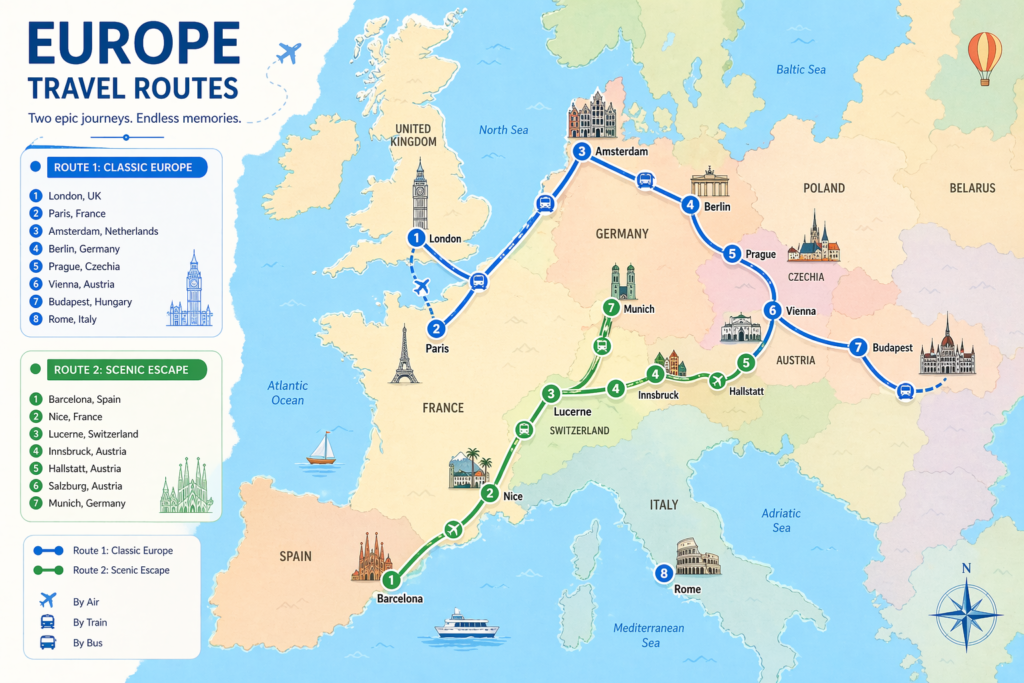
| Day | City / Activity | Key Highlights |
| Days 1–2 | Arrive London | Tower of London, Borough Market, Thames walk |
| Day 3 | Travel: London to Paris (Eurostar) | Train day, arrive evening, settle in |
| Days 4–5 | Paris | Eiffel Tower, Louvre, Montmartre, Seine cruise |
| Day 6 | Travel: Paris to Barcelona (flight) | Arrive midday, explore Gothic Quarter |
| Days 7–8 | Barcelona | Sagrada Familia, Park Güell, La Boqueria |
| Day 9 | Barcelona to Rome (flight) | Arrive evening, Trastevere dinner |
| Day 10 | Rome – depart | Vatican, Colosseum (pre-booked), fly home |
This is a genuinely beginner-friendly route because all four cities are among Europe’s most tourist-infrastructure-rich destinations. English is widely spoken, public transport is excellent, and the route flows logically west to south. Furthermore, it covers four genuinely different cultural experiences in a compact, logical arc.
2-Week Europe Trip Example (Balanced Experience Plan)
| Day Range | City | Transport Method |
| Days 1–2 | Amsterdam | Fly in |
| Day 3 | Bruges (day trip) | Train from Amsterdam |
| Days 4–5 | Brussels | Train from Amsterdam |
| Days 6–7 | Paris | Train from Brussels |
| Day 8 | Lyon (overnight transit) | Train from Paris |
| Days 9–10 | Florence | Train from Lyon |
| Days 11–12 | Rome | Train from Florence |
| Day 13 | Amalfi Coast day trip | Bus/ferry from Naples |
| Day 14 | Fly home from Rome |
This two-week route is one I’ve recommended many times and received rave feedback on. It hits three distinct cultural zones — Northern European/Benelux, French, and Italian — with a logical southward flow that keeps transport efficient. Italy in particular deserves at least 4-5 days, and this plan delivers exactly that.
Multi-Country Europe Trip (Efficient Travel Flow)
For a multi-country trip beyond Western Europe, consider the Central European circuit: Vienna (3 nights) → Prague (3 nights) → Krakow (2 nights) → Budapest (3 nights) → fly home. This circuit works exceptionally well because all four cities are connected by excellent train links, the cultural variation is dramatic, and costs are significantly lower than Western Europe.
Krakow and Budapest in particular represent extraordinary value — world-class architecture, incredible food scenes, and a fraction of the cost of Paris or Amsterdam. In addition, this region rewards slower travel: the deeper you look, the more you find.
Common Mistakes That Kill Your Europe Trip Experience
Overpacking Destinations in Limited Time
I’ve already touched on this, but it deserves its own section because I see it so often. Fitting seven cities into nine days isn’t ambitious — it’s self-defeating. You arrive exhausted, you leave before you’ve connected with the place, and you spend more time on trains than in the cities themselves.
The antidote: cut your city list by at least one city per week of travel. You will not regret it. I promise. Every traveler I’ve spoken to who has done this says the same thing: ‘I wish I’d stayed longer in every place I visited.’
Ignoring Travel Time Between Cities
This is the hidden trip-killer. A flight from Rome to Barcelona looks like two hours — but when you add 90 minutes for airport check-in, 45 minutes of ground transport on each end, and the inevitable 30-minute delay, you’ve lost a full half-day. Therefore, every time you move cities, budget that as a travel day, not a sightseeing day.
Poor Budget Allocation
Most budget mistakes happen at the allocation level, not the total level. Travelers spend money on accommodation and flights but then run out of budget for the experiences that actually matter — guided tours, iconic restaurant meals, tickets to special events. Flip the priority: allocate experience budget first, then fit accommodation and transport around it.
Not Using a Structured Trip Planner
Trying to keep a multi-city Europe trip organized in your head — or in scattered notes across three different apps — is a recipe for missed bookings, double-spending, and constant low-level anxiety. Use one centralized trip planner or template. It doesn’t have to be elaborate. Even a simple Google Sheet with all your dates, cities, accommodation names, and confirmation numbers in one place makes a transformative difference.
Beginner vs Advanced Europe Trip Planning
Beginner Strategy (Simple, Safe, and Efficient)
For first-time Europe travelers, my prescription is always the same: choose two or three countries maximum, fly into and out of the same hub city to simplify routing, book all accommodation in advance (no winging it), and choose cities with strong English-language tourist infrastructure — London, Amsterdam, Barcelona, Paris, and Rome all qualify.
In addition, give yourself at least two full days per city. And on those days, plan only three to four activities maximum — not eight. Europe’s cities are dense with experiences. The best ones are often unplanned: a random side street, a market you stumbled into, a café where you ended up spending three hours.
If you’re considering solo travel, which is a genuinely transformative experience, this curated list of the best solo travel Europe destinations is an excellent starting point for choosing cities that are solo-traveler-friendly.
Advanced Strategy (Optimized Routes and Experiences)
Advanced travelers can unlock a dramatically different Europe experience by thinking beyond the headline cities. Instead of Paris, consider Lyon or Bordeaux. Instead of Rome, consider Bologna or Naples. Beside Barcelona, consider Seville or San Sebastián.
Furthermore, advanced route optimization involves mixing transportation modes strategically — a budget flight here, an overnight train there, a rental car for rural exploration — and timing arrivals in each city to maximize the first and last evenings rather than letting them disappear into check-in logistics.
Europe Trip Planning Checklist (Actionable)
Pre-Planning Checklist
- Define travel goals, style, and non-negotiables
- Set a total budget range (including buffer of 15-20%)
- Choose travel season and specific dates
- Select your country cluster and cities
- Check passport validity (must be valid 6+ months beyond return date)
- Check visa requirements for your nationality
- Research travel insurance options
- Set up a Europe trip planner template or digital system
Booking Checklist
- Book international flights (8-12 weeks in advance for best prices)
- Book accommodation in first and last cities immediately after flights
- Book inter-Europe trains or flights
- Book remaining accommodation
- Purchase travel insurance
- Book tickets for major attractions in advance (Vatican, Sagrada Familia, Uffizi, etc.)
- Arrange airport transfers or pre-load transit apps
- Set up Wise or similar multi-currency card
- Purchase or arrange international SIM card
- Download offline maps for all cities
Final Week Preparation Checklist
- Print or download all booking confirmations
- Check in for flights online (24-48 hours before)
- Notify your bank of international travel dates
- Load all apps: Google Maps (offline), TripIt, Trainline, XE Currency
- Pack light — if in doubt, leave it out
- Do one final review of your day-by-day itinerary
- Confirm all accommodation addresses and check-in procedures
- Share your itinerary with a trusted contact at home
FAQ — Based on Real Search Questions
What is the best way to plan a trip to Europe?
The best way to plan a trip to Europe is to work through a structured five-step process: define your goals, choose geographically clustered countries, set a realistic duration, build a logical multi-city route, and book in the right order (flights first, then accommodation, then transport). Use a centralized planning tool — whether that’s a Google Sheet, Notion template, or dedicated travel planner app — to keep everything organized in one place. Avoid overloading your itinerary, and always build buffer time into every travel day.
How much will a Europe trip cost?
A Europe trip cost varies significantly based on travel style, duration, and destination choices. For a 10-day budget trip, expect to spend $2,200-$3,500 per person including flights. A mid-range 10-day trip runs $3,500-$5,500. A two-week trip at mid-range typically costs $4,000-$6,500 per person. Luxury trips in the same timeframe can run $10,000-$20,000+. The biggest cost variables are international flights (book early for best prices) and accommodation location (central vs. neighborhood-level).
What are the 7 countries Europe trip?
The classic ‘7 countries Europe trip’ typically refers to a Central and Western European circuit covering the UK, France, Belgium, Netherlands, Germany, Austria, and Italy — or variations including Spain and Switzerland. However, visiting seven countries in a single trip is only advisable for travelers with three weeks or more. For shorter trips, I strongly recommend choosing three to four countries and exploring each more deeply. Seven countries in two weeks means averaging two nights per country, which barely scratches the surface of each destination.
Final Action Plan — Plan Your Europe Trip Step-by-Step Today
Your 7-Day Planning Execution Plan
| Day | Task | Outcome |
| Day 1 | Define goals, budget, and travel dates | Clear travel brief |
| Day 2 | Choose countries and city cluster | Route framework |
| Day 3 | Research flights — set Google Flights alerts | Flight shortlist |
| Day 4 | Build initial itinerary using a template | Draft itinerary |
| Day 5 | Book flights and first/last accommodation | Core bookings locked |
| Day 6 | Book inter-Europe transport and remaining stays | Full logistics booked |
| Day 7 | Book attraction tickets, set up payment tools, finalize planner | Trip ready |
Tools and Templates to Start Immediately
You don’t need to spend money to start planning a great Europe trip. Here’s the free stack I recommend for immediate use: Google Flights (flight monitoring), Rome2rio (route research), Trainline (rail booking), Booking.com (accommodation), and a free Notion Europe trip planner template or Google Sheets template for itinerary building. Each of these tools has a free tier that covers 100% of what most travelers need.
How to Avoid Overplanning and Take Action
Here’s the truth about planning a Europe trip that nobody tells you: the perfect plan doesn’t exist. The best trips I’ve ever taken had flexible frameworks, not rigid day-by-day scripts. Plan the anchors — flights, accommodation, one or two must-do experiences per city — and let everything else breathe.
The biggest enemy of a great trip isn’t under-planning. It’s over-planning to the point where you never actually book anything. Set yourself a planning deadline: all bookings locked within three weeks of your departure date being confirmed. After that, stop researching and start packing.
Europe is waiting. And I’ll tell you from experience — no matter how well you plan it, it always exceeds expectations.
Conclusion
Planning a trip to Europe doesn’t have to be overwhelming — it just needs the right structure. Start with your goals, cluster your countries, build a logical route, use a solid template to organize the logistics, and book in the right order. That’s the framework. Everything else is detail.
Whether you’re tackling a 10-day Europe adventure for the first time or building an optimized multi-city Europe itinerary as a seasoned traveler, the principles in this guide will get you from ‘I want to go to Europe’ to ‘I have my bags packed’ in a matter of weeks, not months.
Use the checklists. Steal the example itineraries. Download a free trip planner template and start filling it in today. The sooner you start, the better your prices will be — and the sooner you’ll be sitting in a Parisian café, or watching the sun set over the Colosseum, wondering why you didn’t do this sooner.
Now go plan that trip.