Table of Contents
- Start With the Trip Vision Before Planning Anything
- Build the Foundation of Your Travel Itinerary
- The Step-by-Step Framework for Creating a Trip Itinerary
- What Actually Works in 2026 for Trip Planning
- Real Travel Itinerary Examples
- Mistakes That Kill Travel Experiences
- Beginner vs Advanced Trip Planning
- Practical Checklist Before Finalizing Your Itinerary
- Frequently Asked Questions
- Final Action Plan for Building Your Next Travel Itinerary
- Explore More from VoyagerNest
Why Most Travel Itineraries Fail Before the Trip Even Starts
I’ve planned dozens of trips — and some of my worst travel experiences came not from bad destinations, but from bad planning. If you’ve ever shown up somewhere exhausted, missed something you really wanted to see, or blown your budget in the first two days, this guide is going to feel very familiar.
Most travel itineraries fail for a handful of predictable reasons:
- Overplanning — cramming 10 attractions into a single day
- Underplanning — winging it and missing must-see experiences
- Unrealistic schedules — forgetting that travel between places takes time
- No flexibility — a single delay collapses the whole plan
- Ignoring travel time — that ‘quick 15-minute drive’ is 45 minutes in traffic
What a Good Travel Itinerary Actually Does
From my experience, a solid itinerary isn’t a rigid minute-by-minute schedule. It’s a framework. Here’s what it should actually do for you:
- Reduce stress — you know where you’re going, what you’ve booked, and what’s flexible
- Save money — planning ahead catches better prices on flights, accommodations, and activities
- Maximize experiences — you stop wasting time figuring out what to do next
- Prevent wasted time — no more aimless wandering when you only have 3 days somewhere
Who This Guide Is For
Whether you’re planning your first solo adventure or your tenth family vacation, this guide gives you the exact framework I use. It works for:
- First-time travelers who don’t know where to begin
- Families juggling different preferences and energy levels
- Couples looking to balance relaxation with exploration
- Solo travelers wanting maximum flexibility with minimum chaos
- Anyone planning an international vacation who needs structure without rigidity
| ✅ Why You Can Trust This Guide I’ve personally planned and executed trips across multiple continents — from 3-day city breaks to 3-week international vacations. This guide pulls from real planning decisions, real mistakes, and real frameworks that I’ve refined trip after trip. I’m not giving you generic advice. I’m giving you what actually works. |
Start With the Trip Vision Before Planning Anything
Here’s where most people go wrong: they open Google Flights before they’ve answered the most basic question — what is this trip actually for? Knowing your ‘why’ changes every decision that follows.
Define the Real Purpose of the Trip
Every great trip starts with a single question: What do I actually want from this experience? The answer should shape everything.
- Relaxation — beach resorts, minimal scheduling, late mornings
- Adventure — hiking, extreme activities, remote locations
- Food — restaurant reservations, markets, cooking classes
- Culture — museums, historical sites, local neighborhoods
- Business + leisure (bleisure) — a mix of work commitments and personal exploration
From my experience, the trips that feel most satisfying are the ones where the purpose is clear from day one. If you’re going for relaxation, don’t book 8 activities. If you’re going for culture, don’t pick a beach resort.
Choose the Right Trip Length for Your Destination
Not every destination suits every trip length. What I’ve seen repeatedly is travelers trying to do a 10-day destination in 4 days — and coming back more exhausted than when they left.
- Weekend trips (2–3 days): Nearby cities, nature escapes, known destinations
- 5–7 day vacations: International city trips, regional explorations
- Long-term travel (2–4+ weeks): Multiple countries, slow travel, off-the-beaten-path destinations
If you’re considering a longer international adventure, I break down how to approach that kind of trip in my guide on how to plan a trip to Europe.
Decide What ‘Successful Travel’ Looks Like for You
This is a decision framework I use before every single trip. Ask yourself:
- Do I want to see as much as possible (fast-paced travel) or go deep into fewer places (slow travel)?
- What are my top 3 non-negotiable experiences for this trip?
- What’s my realistic budget — and where am I willing to splurge vs. save?
If slow travel resonates with you, I wrote a full deep-dive on slow travel philosophy and how to do it right.
| 🔑 Key Takeaway Before you open any booking site, answer three questions: What is this trip for? How long do I actually have? What does a ‘successful trip’ look like for me? These answers become your planning filter. |
Build the Foundation of Your Travel Itinerary
Think of your trip like a building. Transportation and accommodation are the foundation. Activities are the furniture. You don’t pick the furniture before you have walls.
Lock in Your Transportation First
Transportation determines your dates and often your budget. Here’s the order I follow:
- Search flights first — use Google Flights with flexible date view to find the cheapest windows
- Compare train vs. flight for short international legs (trains are often cheaper and more central)
- For road trips, factor in fuel, tolls, and overnight stops early
- Always plan airport transfers — how you get from the airport to your accommodation is often overlooked
If you’re doing a road trip, check out my guide on the best road trips in the USA for route ideas and planning tips.
Choose Accommodations Based on Location, Not Just Price
I made the cheap accommodation mistake early in my travel life. I booked a great deal — 40 minutes from everything I wanted to see. I spent more on taxis than I saved on the room.
What actually works: filter accommodations by location first, then price. Prioritize:
- Walkability — can you walk to major attractions?
- Public transport access — is there a metro or bus stop nearby?
- Safety — check neighborhood reviews, not just hotel reviews
- Proximity to at least one key cluster of attractions
Create a Simple Budget Before Adding Activities
Budget planning sounds tedious — but a 15-minute estimate saves you from running out of money on day four. Here’s how I structure it:
- Accommodation (already booked) — fixed cost
- Food per day — estimate low/mid/high options for each meal
- Local transportation — metro passes, day tickets, taxi estimates
- Activities — entrance fees, tours, experiences
- Emergency buffer — I always set aside 10–15% of total budget
| 💡 Pro Tip Use a simple spreadsheet or Notion page to track your estimated vs. actual daily spend. Even one week of tracking transforms how you budget for future trips. |
The Step-by-Step Framework for Creating a Trip Itinerary
This is the section most guides skip — the actual mechanics of building your day-by-day plan. Here’s exactly how to make an itinerary for a trip without losing your mind.
Research Attractions Without Creating Chaos
The biggest mistake I see is people opening 15 browser tabs and ending up with a massive unorganized list they can’t act on. Here’s what actually works:
- Start with Google Maps — search your destination and browse the ‘Explore’ section
- Open a TikTok or Pinterest search for your destination — visual inspiration surfaces hidden gems
- Check Reddit’s r/travel and destination-specific subs for honest recommendations
- Save everything to a Google Maps list called ‘Trip [Destination]’ — not bookmarks, not notes
This gives you one single visual map of every potential attraction before you start scheduling anything.
Group Attractions by Area to Save Time
This is the step that separates good itineraries from great ones. Instead of scheduling by attraction type, schedule by geography.
- Identify your key neighborhoods or zones
- Group attractions within the same zone into the same day
- Plan your daily starting point based on the cluster’s location
- This alone cuts commute time by 30–50% and eliminates the ‘I should have done that yesterday’ regret
From my experience planning city trips — especially in dense destinations like Rome or Paris — zone-based planning makes a trip feel effortless rather than exhausting.
If Italy is on your list, I’ve put together a detailed guide on the best places to visit in Italy that’s already zone-organized for you.
Build Your Days Around Energy Levels
What I’ve seen with almost every travel burnout case: people front-load their days with heavy activity and then crash. Here’s the structure I use:
- Morning (9am–12pm): Major attractions, museums, popular sites — do the highest-priority items when you have energy
- Afternoon (12pm–4pm): Lunch, rest, lighter exploration — walks, markets, cafes
- Evening (5pm–onwards): Flexible time — dining, nightlife, or early rest depending on the next day
Leave Empty Space in Your Schedule on Purpose
This feels counterintuitive but it’s one of the most important rules I follow: plan less than you think you need to.
- Empty slots absorb delays without collapsing your whole day
- Weather changes need buffer time
- The best travel moments are often unplanned — a local festival, a hidden restaurant, a view you stumbled upon
- Burnout prevention — rushing between 8 activities a day is not travel, it’s a workout
| ⚠️ Common Mistake Planning every hour of every day. This guarantees you’ll either miss something or feel like your vacation was more stressful than work. Leave at least 2–3 hours of unscheduled time per day. |
What Actually Works in 2026 for Trip Planning
Trip planning tools have improved dramatically. Here’s my current honest take on what’s worth using.
Use AI and Maps Together Instead of Random Notes
I’ve tested a lot of combinations, and the one that works best: AI for ideas and logic, Google Maps for spatial organization.
- Use AI assistants to generate initial itinerary drafts — ask it to group by zone and account for opening hours
- Ask AI to estimate travel times between attractions using public transport
- Export the AI suggestion into Google Maps as a saved list
- Use Google Maps calendar integration to time-block your days
This workflow takes about 30 minutes and produces a better first draft than hours of manual research.
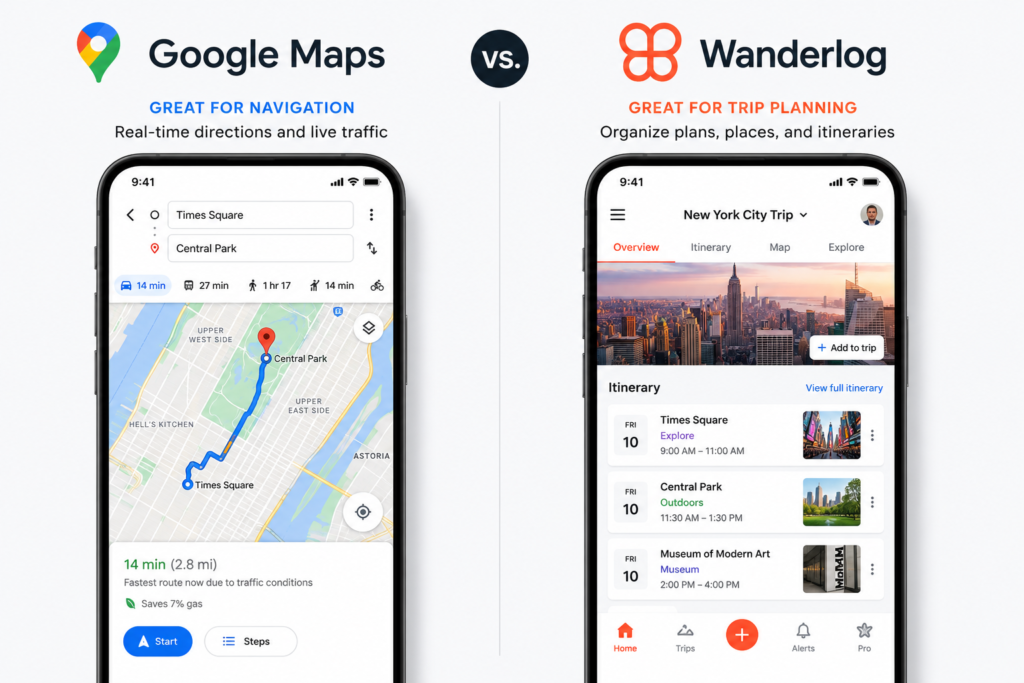
The Best Vacation Planner Apps Worth Using
Here’s my honest breakdown of the apps I actually use and recommend for trip planning:
| App | Best For | Free? | Offline? |
| Google Maps | Route mapping & saving spots | Yes | Yes (downloaded) |
| Wanderlog | Full trip itinerary builder | Yes (Pro available) | Limited |
| TripIt | Auto-organizing bookings | Yes (Pro available) | Yes |
| Notion | Custom planners & databases | Yes | Yes |
My personal go-to: Google Maps for day-to-day navigation + Wanderlog for the overall trip structure. Notion is great if you like building custom dashboards.
Paper Itinerary vs Digital Itinerary
I get this question a lot — should I print my itinerary or keep it digital? Here’s the honest comparison:
| Factor | Paper Itinerary | Digital Itinerary |
| Access without internet | Always available | Depends on app/offline mode |
| Easy to update | No — requires rewriting | Yes — instant edits |
| Sharable with travel mates | No — must copy | Yes — link or export |
| Battery dependency | None | Requires charged device |
| Risk of loss | High — physical copy only | Low — cloud backups |
| Best for | Minimalists, short trips | Most travelers, long trips |
My recommendation: keep a digital itinerary as your primary, but screenshot or PDF key pages for offline access. Best of both worlds.
| 🔑 Key Takeaway In 2026, the best trip planning workflow is: AI for drafting + Google Maps for spatial organizing + one app (Wanderlog or Notion) for your master itinerary. Don’t overcomplicate the tools. |
Real Travel Itinerary Examples
Let me show you what actual itineraries look like — not hypothetical plans, but frameworks I’ve personally used or built for others.
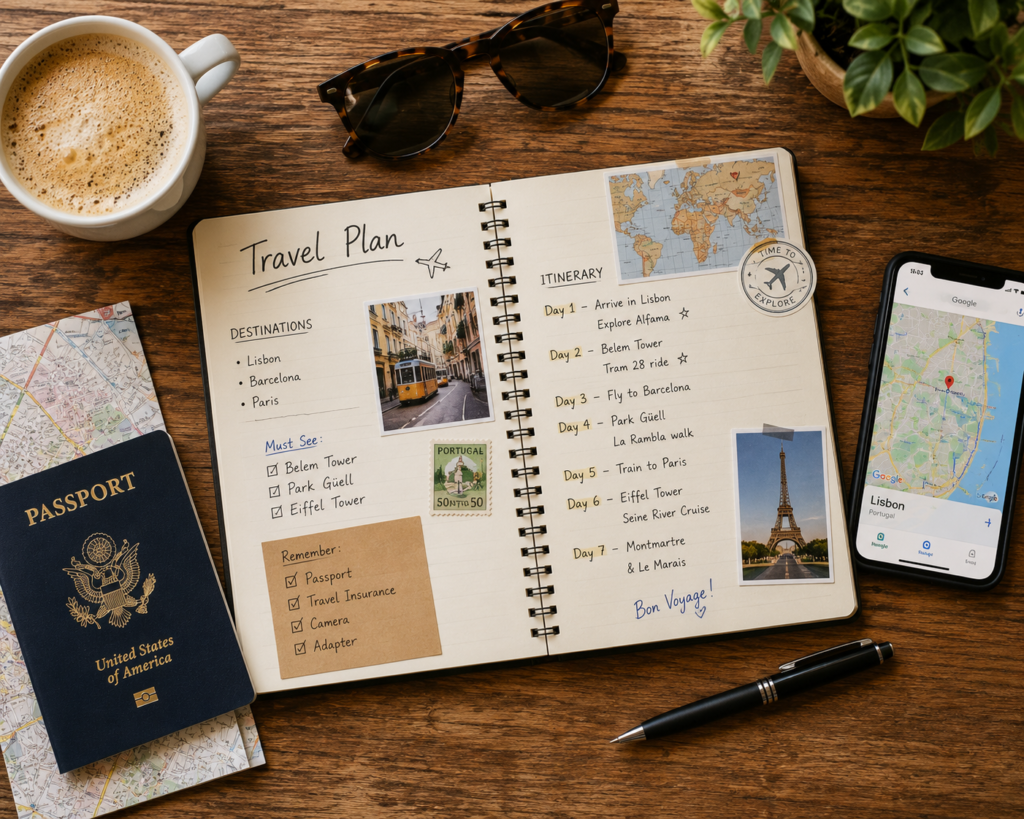
Example of a 3-Day City Trip Itinerary
Destination: Paris, France
- Day 1 — Central Paris Zone: Morning at the Eiffel Tower (book tickets in advance), walk to Champ de Mars, afternoon at Musée d’Orsay, evening along the Seine
- Day 2 — Marais + Louvre Zone: Morning at the Louvre (2–3 hours), lunch in Le Marais, explore Place des Vosges, evening at Sainte-Chapelle
- Day 3 — Montmartre + Local Zone: Morning walk up to Sacré-Cœur, coffee in a local café, afternoon free — shopping or a cooking class, evening departure or extended dinner
Planning a France trip? I’ve covered the best places to visit in France in detail.
Example of a 7-Day International Vacation Plan
Destination: Italy (Rome + Florence + Amalfi)
- Days 1–2: Rome — Colosseum, Vatican, Trastevere, Campo de’ Fiori
- Days 3–4: Florence — Uffizi Gallery, Ponte Vecchio, day trip to Tuscany wineries
- Days 5–7: Amalfi Coast — Positano, boat trip to Capri, beach time, slow evenings
If this is your first time planning an Italy trip, my guide on how to plan a trip to Italy walks through the exact booking sequence.
Example of a Budget-Friendly Trip Itinerary
Budget travel doesn’t mean bad travel. Here’s what I’d change for a $60/day budget (US domestic):
- Accommodation: Hostels or budget motels ($25–$40/night)
- Transport: Megabus or driving over flying; no rental cars in walkable cities
- Food: 1 sit-down meal per day, 2 self-prepared or grab-and-go meals
- Activities: Prioritize free attractions (national parks, walking tours, public beaches)
Check out my guide on best family vacation destinations in the USA — many of these are incredibly budget-friendly.
Mistakes That Kill Travel Experiences
From my experience reviewing travel plans and watching them unfold in real life, these five mistakes appear constantly. Avoid them.
Trying to Visit Too Many Places in One Day
Eight attractions a day sounds ambitious. In practice, it means rushing through everything and fully enjoying nothing. I cap my ‘major attraction’ count at 2–3 per day maximum. Everything else is bonus.
Ignoring Transit and Commute Times
What I’ve seen kill otherwise good itineraries: Google Maps says 20 minutes, but that doesn’t include walking to the metro, waiting for the train, and walking to the venue. Add 40–50% buffer to every transit estimate.
Planning Every Minute of the Vacation
A minute-by-minute schedule works great on paper and collapses the moment your flight lands 30 minutes late, or the museum has a longer queue than expected. Plan anchor points (where you’re going to be), not timestamps.
Forgetting Backup Plans for Weather or Delays
Every good itinerary has a ‘rain day’ backup. What are the indoor alternatives for your outdoor activities? What’s your plan if a train is delayed? I spend 10 minutes per trip on backup planning — it’s never wasted.
Underestimating Travel Fatigue
Even experienced travelers underestimate this. New environments, unfamiliar food, constant stimulation — travel is tiring. Build in recovery time, especially after long flights or transit days. The best trip pace leaves you wanting more, not relieved to go home.
| ⚠️ Common Mistake Summary Too many stops. Ignored transit time. No backup plans. No recovery time. Every one of these is avoidable with 10 minutes of smarter planning. The goal is a trip you remember fondly, not one you survived. |
Beginner vs Advanced Trip Planning
How Beginners Should Plan Their First Trip
If this is your first time planning a trip, keep it simple. Here’s the beginner framework:
- Pick one destination — don’t multi-city your first trip
- Choose 5–7 days — long enough to explore, short enough to manage
- Book accommodation first, then flights (yes, this order matters — confirm where you’ll sleep before locking in travel dates)
- List 5 things you want to do — not 25
- Leave 2 full days unscheduled — let them fill naturally
For first-time international travelers, I recommend starting with Europe. I wrote a comprehensive guide on solo travel Europe destinations that’s beginner-friendly.
How Experienced Travelers Optimize Itineraries
What I do differently now versus my first trips:
- I plan zones, not days — I know my three zones and fill them flexibly
- I pre-book only the top 3 time-sensitive items (popular museums, popular restaurants, transport)
- I use one master Notion page per trip with links to all bookings
- I always research one ‘local neighborhood’ per city that tourists don’t know about
- I build a ‘what if everything goes wrong’ contact list before leaving
When to Use Travel Agencies vs DIY Planning
Travel agencies are underrated for specific trip types. Here’s how I think about it:
- Use a travel agency for: complex multi-country trips, honeymoons with specific requirements, group travel with 8+ people
- DIY planning for: city trips, solo travel, domestic travel, trips you’ve done before
- Hybrid approach: book complex logistics through an agent, keep daily itinerary flexible and personal
Practical Checklist Before Finalizing Your Itinerary
Documents and Reservations Checklist
- Passport valid for 6+ months beyond return date
- Visas applied for and confirmed
- Flight tickets confirmed and saved (screenshot + email)
- Hotel/accommodation confirmations printed or downloaded
- Activity/tour bookings confirmed with reference numbers
- Travel insurance purchased and policy saved
Budget and Currency Preparation Checklist
- Daily budget estimated for accommodation, food, transport, activities
- Emergency buffer (10–15%) set aside
- Local currency arranged or ATM plan confirmed
- Credit card travel fees checked (look for no-foreign-transaction-fee cards)
- Spending tracking app or spreadsheet ready
Transportation Confirmation Checklist
- Airport transfer booked or planned
- Local transport passes researched (metro cards, day passes)
- Car rental confirmed with insurance if applicable
- Ferry/train bookings confirmed for multi-destination trips
- Navigation app downloaded and destination saved offline
Emergency and Safety Preparation Checklist
- Emergency contacts listed and shared with a trusted person at home
- Local emergency numbers saved (police, ambulance, embassy)
- Travel insurance emergency line saved in phone
- Hotel address saved offline in local language
- Digital copies of all documents stored in cloud + email
| 💡 Pro Tip Email yourself a single PDF with all confirmations, emergency numbers, and key addresses before you leave. It’s accessible from any device, anywhere in the world, even without your travel apps. |
Frequently Asked Questions
How many activities should I plan per day?
From my experience, 2–3 major activities per day is the sweet spot. Add 1–2 minor activities (a café, a walk, a market) and leave 2 hours unscheduled. This gives you a full, satisfying day without burnout.
What is the best app for creating a travel itinerary?
Wanderlog is the best dedicated trip planning app — it combines maps, lists, and a day-by-day builder in one place. Google Maps is best for on-the-ground navigation. Notion is best if you want a fully custom planning system.
How far in advance should I plan a trip?
For international trips: 3–6 months for flights and accommodation. 1–2 months for activities and restaurants. For domestic trips: 4–6 weeks is usually enough. Peak travel season? Add 2–3 months to every estimate.
Should I book everything before traveling?
No. Here’s what I always book in advance: flights, accommodation, and the top 2–3 time-sensitive activities (popular museums, famous restaurants). Everything else? Leave flexible. Overbooked itineraries don’t survive contact with reality.
How do I make a flexible itinerary?
Plan anchor points, not timestamps. Instead of ’10am: Museum, 12pm: Lunch, 1:30pm: Market’ — write ‘Morning Zone: Museum + nearby lunch. Afternoon: Market area.’ This gives you structure without rigidity. Keep your list of ‘would love to do’ vs. ‘must do’ clearly separate.
Can AI help with trip planning?
Absolutely — and it’s one of the best use cases for AI tools right now. I use AI to generate a first-draft itinerary, ask it to group attractions by zone, check opening hours for conflicts, and estimate commute times. Then I refine the draft in Wanderlog or Notion. AI does the tedious first pass; I add the human judgment.
Final Action Plan for Building Your Next Travel Itinerary
The 30-Minute Travel Planning System
If you only have 30 minutes to build a first draft, here’s exactly how to spend them:
- Minutes 0–5: Define trip purpose, length, and 3 must-do experiences
- Minutes 5–10: Search flights on Google Flights (flexible dates view), confirm transport options
- Minutes 10–15: Identify 3 accommodation zones; pick the best-located option in budget
- Minutes 15–20: Open Google Maps, search destination, save top 10 attractions to a list
- Minutes 20–25: Group saved locations by zone/neighborhood
- Minutes 25–30: Assign zone clusters to days; mark top 3 items for advance booking
That’s a working first draft. Everything after this is refinement.
Your Simple Repeatable Framework for Every Future Trip
Here’s the exact process I now follow for every trip, distilled to its core:
- Vision: Purpose + Length + Success definition
- Foundation: Transport → Accommodation → Budget
- Research: Google Maps list + zone grouping
- Build: Day-by-day draft with energy-level structuring
- Review: Apply the mistake checklist; add backup plans
- Confirm: Run through the final checklist before departure
This framework works for a 2-day getaway or a 3-week international adventure. The steps are the same — the detail level changes.
What to Do Immediately After Finishing Your Itinerary
- Book your top 3 time-sensitive items today — don’t wait
- Share the itinerary with your travel companions and get their input
- Screenshot or PDF all key sections for offline access
- Add a final review date — revisit your plan 2 weeks before departure for any updates
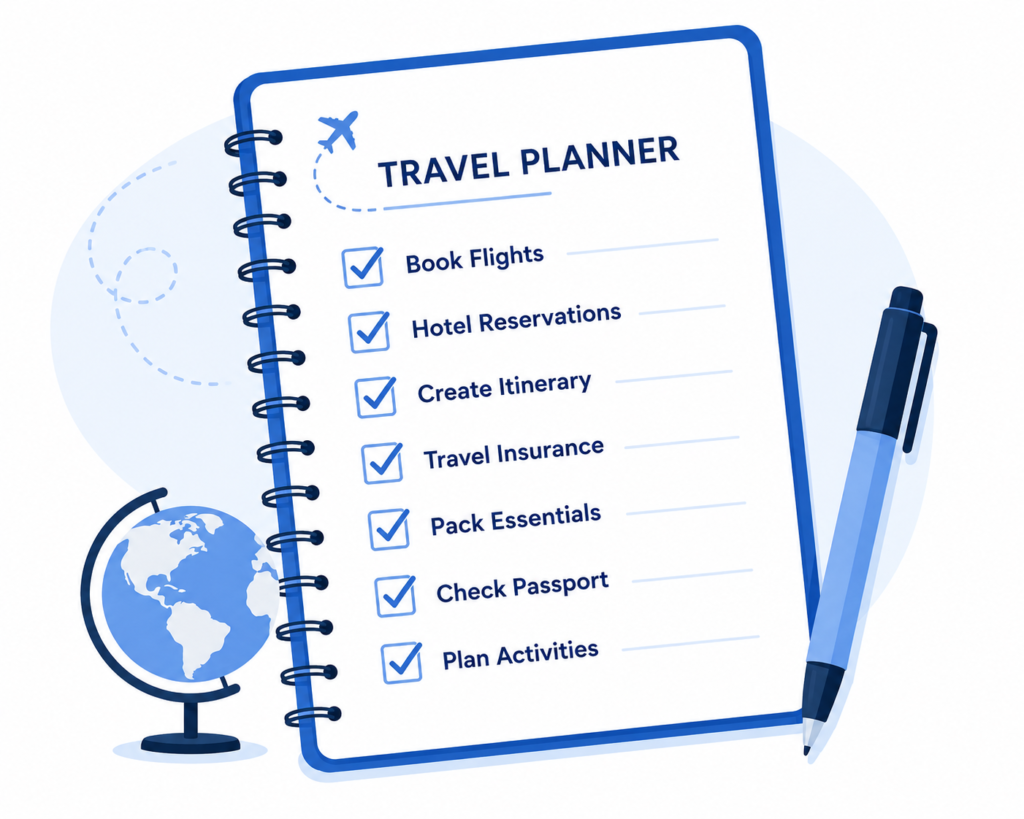
| 🎯 Ready to Start Planning? Here’s Your Next Step Open Google Maps right now. Search your destination. Create a list called ‘Trip [Your Destination]’ and save every place that interests you. That’s step one — and it takes under 5 minutes. Your best trip starts with that single action. |
Explore More from VoyagerNest
Here are related guides that pair well with your trip planning journey: